Quick Answer
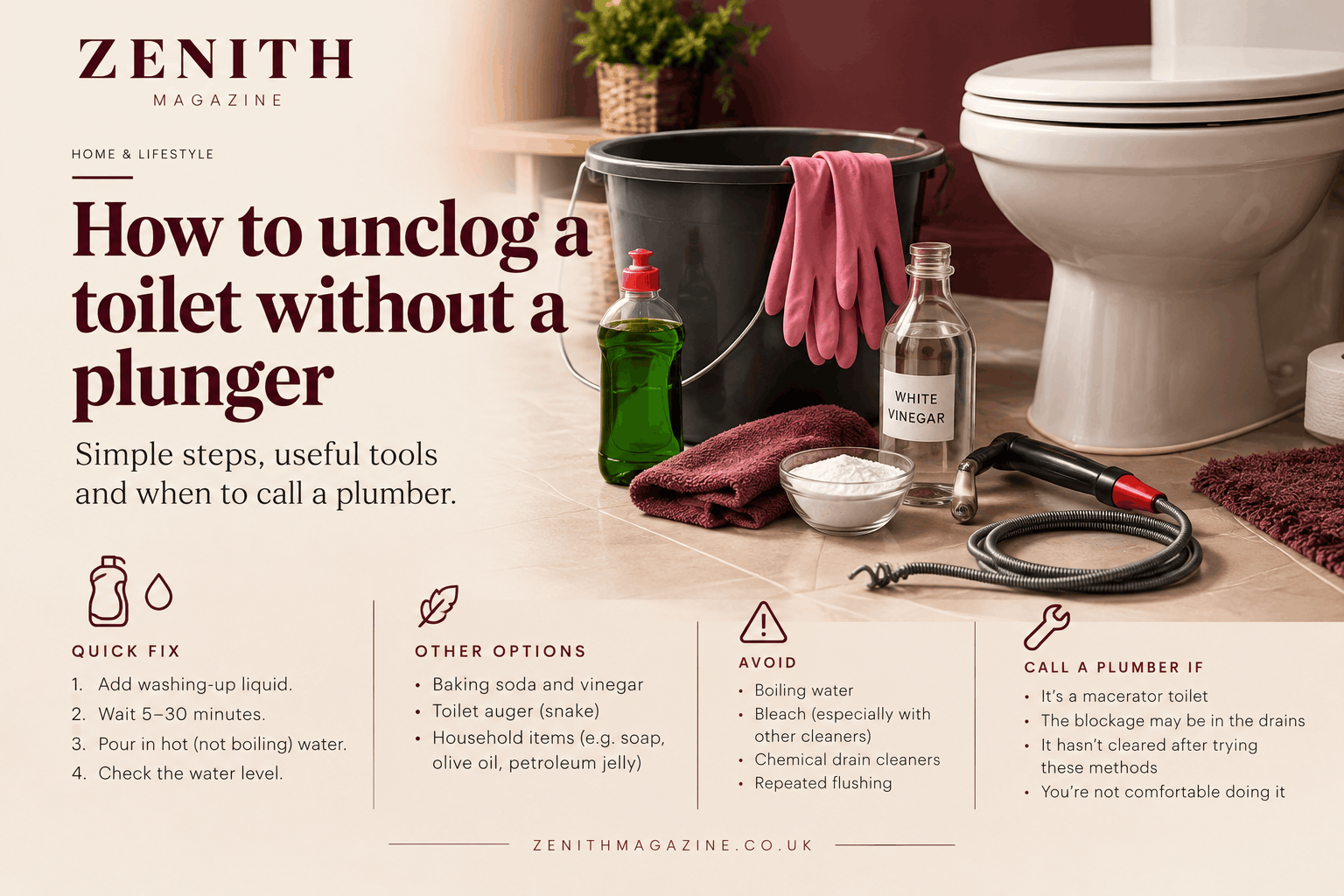
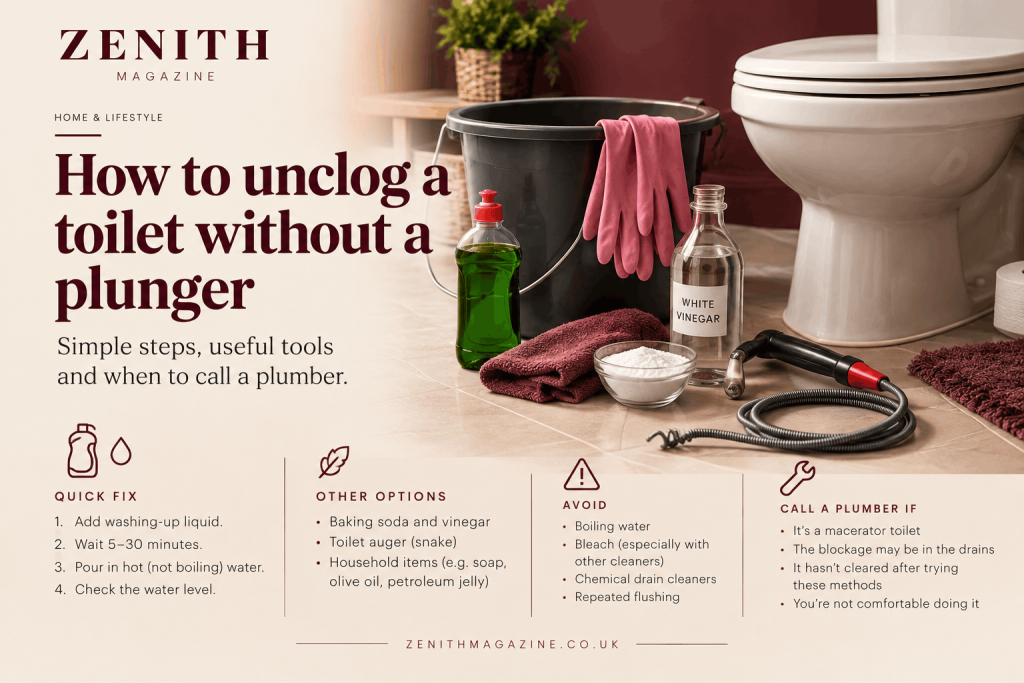
How to unclog toilet without plunger: squirt in washing-up liquid, wait, then pour in a bucket of hot (not boiling) water. If the level does not drop, try a toilet auger or call a plumber. Never mix bleach with other cleaners. Call a professional for macerator toilets, drain blockages, or if you are not comfortable doing it yourself.
Key Takeaways
- Washing-up liquid followed by hot, not boiling, water is the method most UK guides start with. Waiting times in the guides range from about 5 minutes to overnight, so there is no single correct figure.
- Boiling water can crack the porcelain, and chemical cleaners, bleach and homemade fizzing mixtures bring their own risks. Do not combine bleach with other products.
- A blockage made of wipes or other non-flushable items often needs a tool or a professional. The Chartered Institute of Plumbing and Heating Engineering (CIPHE) generally advises calling a plumbing engineer straight away.
A blocked toilet is unpleasant but common, and most of the fixes below use things you already own. Before you start, read the safety notes, because several popular tips (boiling water, bleach, chemical cleaners) can do more harm than good. We have not tested any of these methods ourselves. They come from CIPHE, Water UK and UK home and plumbing guides, which do not always agree.
First checks
Before you start: safety and tidying
CIPHE’s blocked toilet advice sheet says to wear long-sleeved rubber gloves and safety glasses, put on old clothes, protect the surrounding area with newspaper or dust sheets and clear nearby items. Keep a bucket of hot water nearby. Afterwards, thoroughly clean the bowl, the area around it and the underside of the seat.
B&Q, quoted in a news report, adds that you should shut off the water feeding the cistern so it stops refilling, and bail as much standing water as you can into a bucket.
Do not keep flushing
Homebuilding advises trying a half flush, and if the water level does not drop, not flushing again. Repeated flushing risks water spilling over the rim.
Will a toilet eventually unclog itself?
We did not find a source that says how often a blockage clears alone or how long to wait. A small amount of toilet paper may break down. But CIPHE lists warning signs, such as water rising towards the rim or draining very slowly, and says to act early rather than let the problem get worse. A blockage made of wipes or other items will not dissolve, so do not rely on waiting.
How to unclog toilet bowl without plunger: check what is blocking it
If you know what went down, you can choose the right fix. CIPHE lists the usual culprits: wipes (including those labelled “flushable”), kitchen roll and paper towels, cotton wool products, sanitary products and packaging, nappies and contact lenses. Drench, a UK bathroom retailer, suggests that for a small object, such as a child’s toy, you can try removing it by hand, wearing long-arm gloves and eye protection.
Hot water and washing-up liquid
How to unclog a toilet fast with dish soap and hot water
Washing-up liquid acts as a lubricant, according to Ambient Edge. A typical method:
- Pour washing-up liquid into the bowl. Guides vary from half a glass (B&Q) to half a mug around the rim (Drench).
- Wait for the soap to work. Again, guides differ (see the table below).
- Pour in hot water, not boiling. B&Q suggests 2 to 3 litres; Drench suggests a bucketful.
- Wait a few minutes and see whether the water level drops.
- If it has not dropped and the bowl has room, repeat once (B&Q), then switch to another method.
How long to leave dish soap in toilet
| Source | Soap amount | Wait before hot water | Wait after hot water |
| B&Q (news report) | About half a glass | 10 minutes | A few minutes |
| Drench | Half a mug | 30 minutes | 10 minutes |
| Ambient Edge | Half a cup | 5 to 10 minutes | Not given |
| Homebuilding | “Some” | Not given | A couple of minutes |
| HomeTips (US) | About half a bottle | Overnight | 15 to 20 minutes |
If the water level starts to fall, it is working. Drench says to watch the water line and look for some drainage.
Does boiling water unclog a toilet?
Boiling water is not recommended. Homebuilding says to use hot but not boiling water because boiling water may crack the pan. Drench also warns it could crack the porcelain, and Ambient Edge says not boiling, especially with PVC pipes. HomeTips says boiling water could damage the porcelain. Drench’s approach is to use hot water from the kettle but not boiling, and only when the bowl’s water level is low.
How to unclog a toilet naturally without a plunger
The most “natural” options in the guides are washing-up liquid, hot water and baking soda with vinegar, covered here. They are gentle on the toilet, but none of the guides we read measures how well they work.
How to unclog a toilet with baking soda and vinegar
Quantities vary:
- Drench: half a cup of baking soda, then half a cup of white vinegar, then 2 litres of hot (not boiling) water. Wait about 30 minutes, check the water level has dropped back to normal, then flush.
- Ambient Edge: one mug of baking soda and two mugs of vinegar, wait about 30 minutes, then follow with hot water.
- Homebuilding uses soda crystals with vinegar, poured slowly “to avoid a mess”, left for maybe half an hour, followed by warm water. It says this is best for smaller blockages.
How to use Epsom salt to unclog a toilet
HomeTips, a US site, suggests pouring in about 1 cup of Epsom salt and leaving it for a few hours before testing the flush. It gives no evidence that it works, and none of the UK guides we read mention it.
Unclog toilet with Coke or Pepsi
Hunker, a US site, suggests leaving a 20-oz (roughly 590ml) bottle of Coca-Cola in the bowl overnight. It cites no expert or test result and says the Coca-Cola Company disputes such claims. It does not mention Pepsi. Treat this as a hack of unknown effectiveness.
Improvised tools
How to unclog a toilet with a plastic bottle
Two versions appear. HomeTips says to fill a flexible plastic bottle with water, place the opening over the drain and squeeze to force water down. Ambient Edge describes a homemade plunger: cut the bottom off a plastic bottle, seal the top with plastic wrap and a rubber band, then plunge with the open end down, keeping the bottle fully underwater.
Can you use a plastic bag to unclog a toilet?
Homebuilding describes wrapping a plastic bag around a toilet brush and using it to create suction, “kind of faking a plunger effect”, and admits it is not elegant. It should be thrown away afterwards.
How to unclog a toilet with cling wrap
Drench describes this method: dry the bowl’s rim, apply three layers of cling film and press firmly to seal, flush, then gently push the ballooned film down. It says this may not work with low water pressure.
How to use a wire hanger to unclog a toilet
Homebuilding says to bend a wire hanger into a hook and carefully fish out or loosen the blockage. Drench says to straighten it into a U-shape and push and pull through the trap. Both warn that it can scratch the porcelain, so avoid it if the condition of the bowl matters.
How to use a toilet auger snake
A toilet auger is a flexible tool with a handle. Drench says to feed it in until you feel the blockage, then rotate the handle while pushing, and the tip can pierce or retrieve the blockage. Homebuilding calls it “not pretty” but “straightforward and effective”.
How to break up a toilet clog manually
If you are willing, you can break up a clog manually using an auger, a hanger or by hand for a small object, always with gloves and eye protection. CIPHE notes that the work is unpleasant and not always suitable for DIY. If you do not feel comfortable, call a professional.
Fixing a toilet blocked with baby wipes
Wipes do not break down. CIPHE says kitchen roll, tissues and wipes “just compound into a solid mass”, and Water UK says flushable products can cause blockages further down the sewer. We did not find a source on the best way to clear a wipe blockage specifically. The tools above (an auger, which can retrieve a blockage, or removal by hand with gloves) are the realistic DIY options, and a professional is the sensible choice if they fail.
Which improvised method for which situation?
| Method | What the guides say | Caution |
| Washing-up liquid and hot water | The first method most UK guides try | Not boiling water; repeat once at most (B&Q) |
| Baking soda or soda crystals and vinegar | Best for smaller blockages (Homebuilding) | Wait about 30 minutes; no evidence of effectiveness |
| Plastic bottle plunger | Homemade suction (Ambient Edge, HomeTips) | Needs a good seal |
| Toilet brush in a plastic bag | Fakes a plunger (Homebuilding) | Throw the bag away |
| Cling film | Seal the bowl, then flush (Drench) | May fail with low water pressure |
| Wire hanger | Fishes out or loosens a clog | Can scratch the porcelain |
| Toilet auger | Straightforward and effective (Homebuilding) | Messy |
If you do own a plunger, CIPHE says to start with one. If you have none, it says a traditional mop can be used, but never reuse it afterwards.
What not to flush, and what not to pour in
What not to flush
CIPHE and Water UK give the same rule: only pee, poo and toilet paper. Water UK’s “Bin the Wipe” campaign says that when you use a wet wipe, put it in the bin, not down the loo. It warns that products labelled as flushable can still cause blockages further down the sewer line. The Water UK page we read is dated 1 April 2015. Check for a newer version.
Chemical drain cleaner for toilet clog
CIPHE’s advice sheet covers drain un-blocker chemicals, saying they are very powerful and dangerous if you breathe the fumes or they touch your eyes or skin. Open doors and windows first, read and follow the manufacturer’s label, and, in CIPHE’s words, “If in doubt, don’t use it.”
Mr Rooter, a US plumbing firm, says drain cleaner is designed for sink drains, not toilets, can cause chemical burns, may damage fixtures and may worsen the blockage. If you have used a drain cleaner, tell your plumber so they are not caught by a splash.
Bleach to clear toilet blockage
We did not find a UK source that recommends bleach to clear a toilet blockage. The risk is mixing it with other products. Ideal Home reports that bleach with toilet cleaner can produce chlorine gas, bleach with ammonia produces toxic chloramine, and it advises against mixing drain cleaners with bleach. The British Institute of Cleaning Science’s Neil Spencer-Cook is quoted saying chemical interaction is the greatest danger. Do not use bleach on top of anything else in the bowl.
When to call a plumber
When to call a plumber for a blocked toilet
CIPHE generally advises calling a plumbing engineer “straight away” for a blocked toilet, because removing a blockage is unpleasant and not always suitable for DIY. Stop and call if:
- You have a mechanical (macerator) toilet. CIPHE says only toilet paper should be flushed, anything else can damage the motor, and you should not try to clear it yourself.
- The blockage may be in the drains outside. CIPHE does not recommend DIY drainage work, especially outside, because manhole covers can be heavy and deep. Drench suggests lifting the nearest drain cover to see whether the chamber is full, but given CIPHE’s warning, treat that as a professional’s job.
- The methods above have not worked. Drench says not to be afraid to call in a professional.
- You have used chemical drain cleaner, so the plumber is warned (Ambient Edge).
- You are not comfortable with the job. CIPHE says to call a professional if at any point you do not feel comfortable.
CIPHE also advises agreeing the cost with the engineer first, which might be hourly, a call-out fee or a specialist equipment charge. It describes blocked toilets as a potential health hazard because of bacteria in blocked sewers and drains.
Frequently Asked Questions
How do you clear a blocked toilet with things you already own?
Squirt washing-up liquid into the bowl, wait, then pour in a bucket of hot but not boiling water. If the level does not fall, baking soda with vinegar, a homemade bottle plunger or an auger are the other options. If nothing works, call a plumber.
How long should you leave washing-up liquid in a toilet?
Guides disagree. B&Q suggests 10 minutes, Ambient Edge 5 to 10 minutes, Drench 30 minutes, and one US site overnight. Add hot (not boiling) water afterwards. If the water level starts to drop, the method is working.
Is it safe to use boiling water on a toilet?
No. Homebuilding, Drench and Ambient Edge all say to use hot water that is not boiling, because boiling water could crack the porcelain. Ambient Edge adds the warning applies particularly with PVC pipes. Use hot water from a bucket or tap instead.
Does baking soda and vinegar unblock a toilet?
Guides suggest it for smaller blockages, leaving it about 30 minutes before hot water. We found no test of how well it works. Quantities vary between guides, so follow one guide’s measures rather than mixing advice.
Can you flush wipes labelled flushable?
No. CIPHE says to flush only pee, poo and toilet paper, and that wipes, including those labelled flushable, can compound into a solid mass. Water UK warns that flushable products can cause blockages further down the sewer, so bin them.
When should you call a plumber for a blocked toilet?
CIPHE generally advises calling a plumbing engineer straight away, and always for macerator toilets or blockages outside in the drains. Also call if the methods above fail or you are not comfortable. Agree the cost before the work starts.