Quick Answer
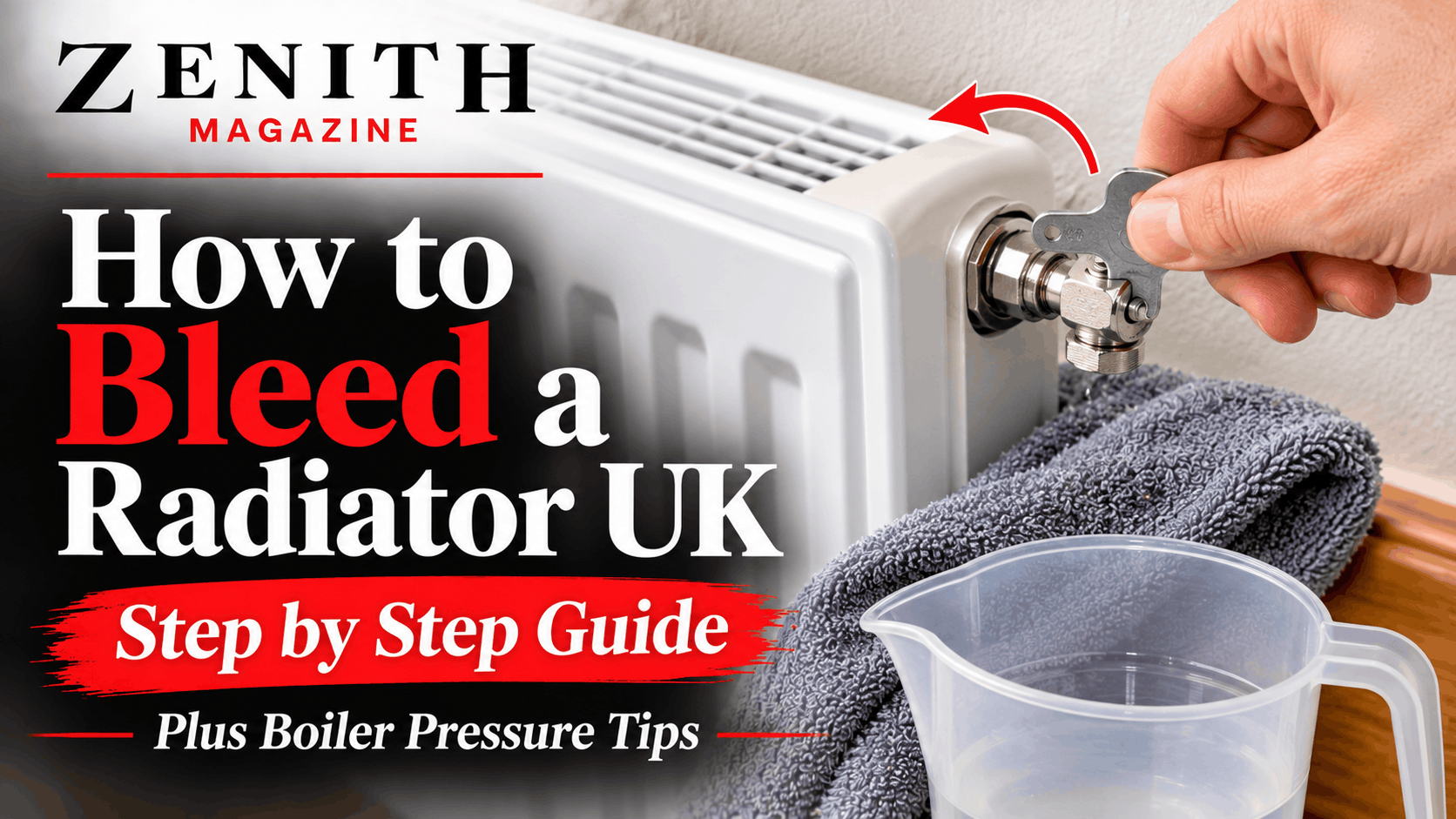
How to bleed a radiator UK: turn the heating off and let it cool, hold a cloth under the bleed valve and turn it anticlockwise a quarter to half a turn with a radiator key. Close it when the hiss stops and water appears. Start with the downstairs radiator furthest from the boiler. Check the gauge and, if pressure is below 1 bar, top up with the filling loop.
Key Takeaways
- Bleeding fixes a radiator that is cold at the top, not one that is cold at the bottom. A cold bottom points to sludge, which needs an engineer’s assessment.
- Most UK boiler guidance puts healthy pressure at 1 to 1.5 bar. Check it after bleeding, because releasing air can lower it.
- The guides disagree on whether to run the heating first to find cold spots. Switch it off and let the system cool before opening any valve.
A radiator that is warm at the bottom and cold at the top usually has air trapped inside it. Releasing it takes a few minutes and a cheap key. This guide follows boiler maker advice (Vaillant, Ideal) and UK energy and heating guides, and sets out where they differ. We have not bled a radiator for this article, so everything here comes from the sources named. Check your boiler manual, because pressure and filling loops vary by model.
Signs you need to bleed
Radiator air lock symptoms
Fuse Energy (23 June 2026) says the main sign is a radiator that is “cold at the top but warm at the bottom”. Other signs are gurgling or bubbling in the pipes or radiators, slow heating and uneven temperatures between rooms. EDF Energywise (20 January 2026) also links cold tops to trapped air, which can make the radiator noisy.
Radiator cold at bottom after bleeding
If a radiator is cold at the bottom, bleeding is unlikely to help. iHeat (last updated 25 September 2026) says bleeding usually does not fix it, because bleeding releases air that causes a cold top, and “sludge or deposits towards the bottom cannot simply be released through the bleed valve.” EDF says a cold bottom with a warm top suggests debris, a blockage or sludge. Sludge is corrosion debris that builds up inside a heating system. Fuse Energy calls it magnetite.
Tools
You need a radiator bleed key, an old cloth or towel and a small container. Fuse Energy and Appliances Direct list a flat-head screwdriver as an alternative on some modern radiators.
How to use a radiator bleeding key
How to use a radiator bleeding key: Checkatrade describes the bleed valve as a round hole with a square within, which is where the key fits. Turn the key anticlockwise to open it, and clockwise to close it (Ideal). Do not unscrew the valve fully.
Where to buy a radiator bleed key
Where to buy a radiator bleed key: Checkatrade says keys are available at many DIY shops. They are also stocked by plumbing merchants and online retailers (our reading; we did not check prices).
How to bleed a radiator without a key
How to bleed a radiator without a key depends on the valve. If it has a slot, the sources say a flat-head screwdriver can do the job (City Plumbing, 3 October 2023; BookaBuilderUK, 20 June 2026). If it is a square-only valve, we found no safe substitute. BookaBuilderUK warns that “pliers often round off the bleed screw”, so buy the key.
How to bleed a radiator with a screwdriver
How to bleed a radiator with a screwdriver follows the same steps as with a key. Insert the screwdriver into the slot and turn it anticlockwise slowly by a quarter to half a turn. City Plumbing warns that “excessive force can damage the valve mechanism or the radiator itself”.
How to bleed a radiator with a flathead screwdriver
How to bleed a radiator with a flathead screwdriver applies only to slotted bleed valves. Check the valve first. Fuse Energy says some modern radiators take a flat-head screwdriver or an Allen key instead of a key.
How to bleed a radiator that has a plastic cap
We found no source on how to bleed a radiator that has a plastic cap on the bleed valve. The only plastic cap in our sources is on the lockshield valve at the other end of the radiator, which Heatable says to remove to isolate the radiator. Do not confuse the two. If you cannot find or access the bleed valve, ask a heating engineer.
Automatic radiator bleed valve UK
An automatic radiator bleed valve UK homes can fit lets air escape without a key. City Plumbing notes that some modern radiators already have automatic air vents. Retailers sell fit-your-own versions, but we could not read a product page, and BookaBuilderUK says to depressurise the system before removing a bleed valve. Treat fitting one as a job for an engineer unless the product instructions say otherwise.
The steps
How to bleed a radiator UK step by step
- Turn the heating off and let the radiators cool. Fuse Energy warns that “bleeding a hot radiator can be dangerous” because hot water or steam can spray out.
- Check the boiler pressure on the gauge before you begin (see below).
- Put a towel under the bleed valve, usually at the top corner, and hold a container ready.
- Turn the key anticlockwise a quarter to half a turn. Do not unscrew it fully.
- Wait for the hiss of air to stop and water to trickle out, then turn the key clockwise to close it.
- Repeat on other radiators that are cold at the top.
- Check the pressure again and top up if needed.
Checkatrade and City Plumbing start by turning the heating on so you can feel which radiators have cold spots, then switch it off before bleeding. Appliances Direct warns that bleeding with the heating on can send out “hot, black sludge-water” because pump pressure can force it out.
Central heating bleeding sequence: when to bleed radiators upstairs or downstairs first
For the central heating bleeding sequence, Ideal Home (4 October 2026) says to start with downstairs radiators, beginning with the one furthest from the boiler, then move upstairs and repeat. Alex Woods of Victorian Plumbing is quoted saying that because air rises, any remaining air will be moved upwards. Appliances Direct and Fuse Energy give the same order.
When to bleed radiators upstairs or downstairs first is a common question. Matthew Powell of WarmZilla tells Ideal Home that the wrong order is unlikely to damage the system but is less efficient, and may mean going back to check the upstairs radiators again.
Radiator bleeding valve hiss no water
For a radiator bleeding valve hiss no water, Appliances Direct says to keep the valve open until the hiss stops and water trickles out. City Plumbing says that hearing no hiss at all typically means there is no trapped air in that radiator. We found no source for a valve that keeps hissing without ever producing water. If that happens, close it and ask an engineer (our reading).
Radiator bleeding water color black
Radiator bleeding water color black is a sign of debris. Appliances Direct mentions “hot, black sludge-water” coming out of the bleed valve. Checkatrade warns the water may be dirty and to protect the floor. The sources do not give a test, but black water suggests sludge in the system, which an engineer can assess. iHeat says a professional power flush may be considered when contamination affects multiple parts of the system, and a single cold-bottom radiator does not automatically need one.
Water coming out of radiator bleed valve won’t stop
If water keeps coming from the bleed valve, close it gently. Heatable says to use the key to turn the screw clockwise until it feels snug, and not to overtighten. If it keeps leaking or feels rounded, the valve may need replacing. To isolate the radiator, Heatable says to turn both radiator valves clockwise, remove the plastic cap on the lockshield valve if needed, and count the turns so you can reopen it to the same position. If you cannot isolate the radiator, turn off the heating and call a professional.
Radiator valve stuck won’t turn
If a radiator valve is stuck and won’t turn, do not force it. BookaBuilderUK warns that threads can break free suddenly if heavily corroded, and EDF says to call a professional to replace a seized valve.
How to bleed a radiator when the valve is rounded off
How to bleed a radiator when the valve is rounded off: BookaBuilderUK says pliers often cause this and advises a square brass key or a flat-head screwdriver for slotted types. Once a valve is rounded off, Heatable says the bleed valve may need replacing, which is a job for a plumber.
Checking boiler pressure
How to bleed a radiator without messing up the pressure
How to bleed a radiator without messing up the pressure: note the gauge reading before you start, bleed only the radiators that need it, and check the gauge again before you turn the heating back on. Powell advises checking boiler pressure before restarting the heating, and Fuse Energy says bleeding can lower boiler pressure.
The usual range from boiler makers is 1 to 1.5 bar. Vaillant says the gauge “should generally read between 1 and 1.5 bar” and warns against pressure above 2.5 bar. British Gas says “ideally, the gauge should read between 1 and 1.5.” Checkatrade describes the gauge colours instead: the needle should point to green, with yellow meaning top up.
Boiler pressure dropped after bleeding radiators
Boiler pressure dropped after bleeding radiators is normal. British Gas says bleeding can lower pressure, so repressurise afterwards. If it keeps dropping, leaks are a main cause, according to British Gas. Vaillant says to contact an installer if pressure won’t rise or keeps dropping, which can point to a leak or faulty part.
How to repressurise boiler after bleeding radiators
How to repressurise boiler after bleeding radiators, using Vaillant and British Gas steps for boilers with an external filling loop:
- Check your boiler’s manual first, because instructions vary by model.
- Turn the boiler off and let it cool.
- Find the filling loop, a flexible hose with a valve at each end under the boiler.
- Open both valves slowly and watch the gauge rise.
- Close both valves once the gauge reads 1 to 1.5 bar, and check they are fully shut.
- Remove the loop if it is detachable.
- Turn the boiler back on and check the pressure stays steady.
British Gas notes that Worcester Bosch boilers use a different process. Vaillant’s own page also says it recommends having an expert do it, so if you are unsure, ask an engineer. If pressure is too high, Ideal says to release water by bleeding a radiator into a bucket, and Vaillant says to avoid pressure above 2.5 bar.
Bled radiator and now none of them are working
If you have bled a radiator and now none are working, check the basics. EDF says to check the heating is switched on, then consider low boiler pressure or a faulty diverter valve if several radiators are cold. Check the pressure before bleeding again. If you have hot water but no central heating, EDF suggests calling a Gas Safe engineer.
When to call an engineer
Bleeding a radiator is not gas work, but a boiler fault is. British Gas warns: “Never look inside your boiler though, only a Gas Safe engineer should do this.” Call an engineer if any of these apply:
- Cold spots, uneven heating or noises persist after bleeding and checking pressure (Fuse Energy).
- Boiler pressure keeps dropping after you repressurise (Fuse Energy, Vaillant).
- You see leaks, corrosion or damage to a radiator or its pipework (Fuse Energy).
- The bleed valve sprays or leaks under pressure, or you cannot isolate the radiator (BookaBuilderUK, Heatable).
Radiator still cold at top after bleeding
If a radiator is still cold at the top after bleeding, Checkatrade says to call a professional in to inspect the system. EDF says to check the pressure before bleeding again, and notes that air can move around the system after the first bleed.
Why does my radiator keep filling with air
Why does my radiator keep filling with air? EDF says air can move around after the first bleed and to check for leaks if the problem persists. Appliances Direct says that if you are bleeding radiators constantly, it may be worth calling a heating engineer to check for an underlying problem. We found no source that lists causes with confidence..
Frequently Asked Questions
How do you bleed a radiator and top up boiler pressure?
Turn the heating off, open the bleed valve a quarter to half a turn until water appears, then close it. Check the gauge. If it is below 1 bar, top up with the filling loop to 1 to 1.5 bar, following your manual.
When to bleed radiators upstairs or downstairs first?
Start downstairs, with the radiator furthest from the boiler, then repeat upstairs, according to Ideal Home, Appliances Direct and Fuse Energy. Air rises, so any left behind is pushed upwards. The wrong order is unlikely to cause damage but is less efficient.
Why does my radiator keep filling with air?
Air can move around the system after the first bleed, so a second bleed is sometimes needed. If it keeps happening, EDF says to check for leaks and Appliances Direct suggests calling a heating engineer.
Bled radiator and now none of them are working?
Check the heating is on, then the boiler pressure, which bleeding can lower. Top it up to 1 to 1.5 bar if needed. If radiators stay cold, EDF says low pressure or a faulty diverter valve may be the cause, and to call a Gas Safe engineer.
Why is my radiator cold at the bottom after bleeding?
Bleeding releases air, which causes a cold top. A cold bottom usually points to sludge or debris, which iHeat says cannot be released through the bleed valve. Ask an engineer to assess it.
How to bleed a radiator without a key?
Only if the valve has a slot. A flat-head screwdriver works on slotted bleed valves, according to City Plumbing and BookaBuilderUK. Do not use pliers, which can round off the valve. If in doubt, buy a key.