Quick Answer
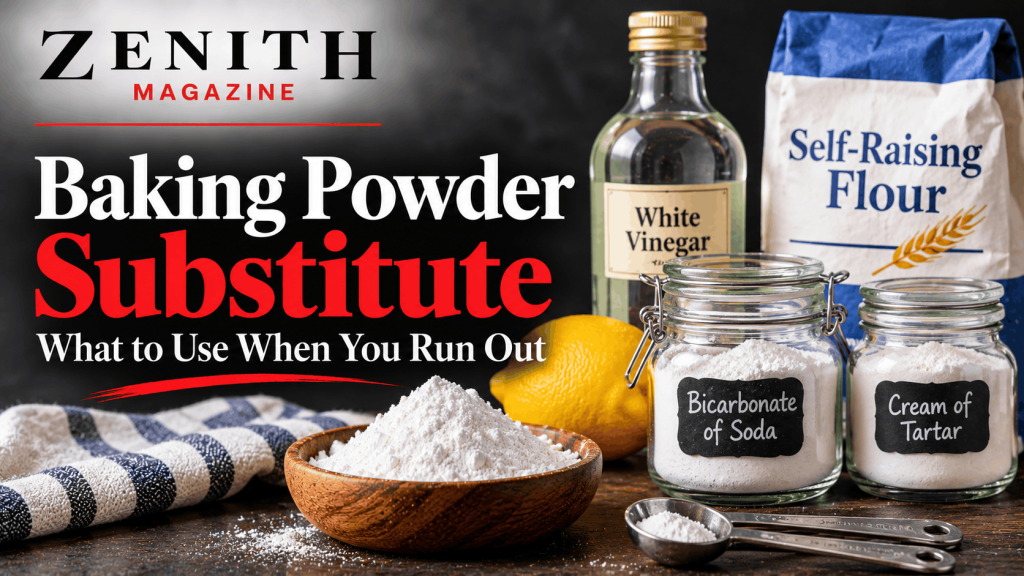
The best baking powder substitute is bicarbonate of soda plus an acid. For each teaspoon of baking powder, use 1/4 teaspoon bicarbonate with 1/2 teaspoon cream of tartar, lemon juice or white vinegar, and bake straight away. Self-raising flour can replace plain flour plus baking powder. Never swap bicarbonate for baking powder spoon for spoon, because it needs the acid to work.
Key Takeaways
- Baking powder is bicarbonate of soda with an acid and a starch already mixed in. To rebuild it, you need to supply the acid yourself.
- Yoghurt, buttermilk and molasses also work with bicarbonate, but they add liquid or sugar, so the recipe needs small adjustments.
- Cornflour is only the filler in baking powder, not the part that makes a bake rise.
Running out of baking powder halfway through a recipe is common, and most kitchens already hold a workable fix. The ratios below come from King Arthur Baking, America’s Test Kitchen, Silver Spoon (British Sugar’s baking site), Tasting Table and others. We have not baked the swaps ourselves, so we cannot say how a sponge turns out. The sources agree on the basic ratio and differ on the details, which we flag.
Bicarbonate and an acid
How baking powder works
America’s Test Kitchen describes baking powder as a “double action” leavener, combining baking soda (known in UK recipes as bicarbonate of soda) with a powdered acid and cornflour. Bob’s Red Mill says baking soda is sodium bicarbonate, and needs moisture plus an acidic ingredient to react. Double-acting baking powder reacts twice: once when it gets wet and again when heated, which is why a batter can rest briefly before baking.
Baking powder substitute baking soda
For a baking powder substitute baking soda needs an acid. Baking soda on its own will not do the job. Bob’s Red Mill says baking powder can replace baking soda, but baking soda cannot replace baking powder, because it lacks the acid the batter needs to rise.
Baking powder vs baking soda conversion
For baking powder vs baking soda conversion, there is no simple one-for-one swap. King Arthur says you cannot substitute equal amounts either way. If you only have baking powder and a recipe wants baking soda, The Takeout and King Arthur say to use three times as much baking powder, and King Arthur warns the result can taste slightly bitter. In the other direction, The Takeout says to mix one part baking soda with two parts of an acid such as cream of tartar or white vinegar.
Emergency baking powder substitute
For an emergency baking powder substitute, this table pulls together the main options, per 1 teaspoon (5g) of baking powder. Where sources give different amounts, both are shown.
| Swap | Amount | Source |
| Bicarbonate and cream of tartar | 1/4 teaspoon bicarbonate and 1/2 teaspoon cream of tartar, used immediately | King Arthur, America’s Test Kitchen |
| Same, in grams | 1g bicarbonate and 2g cream of tartar | Silver Spoon |
| Bicarbonate and lemon juice or white vinegar | 1/4 teaspoon bicarbonate and 1/2 teaspoon lemon juice or vinegar | King Arthur, Tasting Table |
| Bicarbonate and plain yoghurt | 1/4 teaspoon bicarbonate and 1/2 cup (122g) plain yoghurt | Tasting Table, Silver Spoon |
| Bicarbonate and buttermilk | 1g bicarbonate and 122g buttermilk | Silver Spoon |
| Bicarbonate and molasses | 1/4 teaspoon bicarbonate and 1/4 cup (84g) molasses | Tasting Table, Silver Spoon |
| Whipped egg whites | 2 egg whites, whipped to stiff peaks and folded in | Silver Spoon |
Tasting Table’s cream of tartar guidance, 2/3 teaspoon of cream of tartar and 1/3 teaspoon of bicarbonate for each teaspoon, keeps the same 2:1 split but uses more in total than King Arthur’s. Start with King Arthur’s and America’s Test Kitchen’s amounts.
Baking powder substitute cream of tartar
For a baking powder substitute cream of tartar is the standard acid. King Arthur describes it as a powdered form of tartaric acid. King Arthur’s version adds 1/4 teaspoon of cornflour or tapioca starch to the mix. America’s Test Kitchen’s version leaves it out and says to use it immediately.
Baking powder substitute lemon juice
For a baking powder substitute lemon juice works with bicarbonate in the amounts above. Tasting Table says bottled lemon juice is fine when it is only acting as a raising agent, and fresh is better where lemon is a key flavour.
Baking powder substitute vinegar
For a baking powder substitute vinegar can do the same job. Silver Spoon recommends white wine vinegar for its neutral flavour and colour, and warns that vinegar’s taste can be overpowering in large amounts, so use it only where the recipe needs a small amount of baking powder.
Baking powder substitute using yogurt or buttermilk
For a baking powder substitute using yogurt or buttermilk, bicarbonate does the lifting and the dairy supplies the acid. Silver Spoon says plain, unsweetened yoghurt is best because flavoured yoghurt can change the taste and consistency. Both add liquid, so reduce the other liquid in the recipe by the same amount. Tasting Table says Greek yoghurt needs further adjustments to other liquids.
Self-raising flour
Self raising flour instead of baking powder
Self raising flour instead of baking powder works if you swap it for the plain flour in the recipe and leave the baking powder out. Self-raising flour is plain flour with baking powder already mixed in. Nigella’s site gives the proportion for making it as 2 teaspoons of baking powder per 150g of plain flour, with no salt in UK versions. Our arithmetic from that: a recipe that uses 150g plain flour and 2 teaspoons of baking powder can use 150g self-raising flour instead. This is not stated directly by a source, so check your recipe. For more on swapping the two flours, see: [link placeholder /internal-link-ZM-032].
King Arthur gives a US recipe for self-rising flour of 1 1/2 teaspoons of baking powder and 1/4 teaspoon of salt per 120g of all-purpose flour. Salt is the main difference between US and UK versions.
Baking powder substitute no baking soda
For a baking powder substitute no baking soda is needed, the sources give three routes:
- Self-raising flour, as above.
- Whipped egg whites, 2 per teaspoon of baking powder, folded in gently. Silver Spoon says this suits light, airy recipes. Tasting Table warns over-mixing beats the air out.
- Carbonated water in place of the other liquids. Silver Spoon says it is best for pancakes and quick breads, and probably will not work for light cakes or soufflés. Tasting Table says club soda can leave a batter stodgy.
When it will not work
Can I use cornstarch as a baking powder substitute?
Can I use cornstarch as a baking powder substitute? No. Discover magazine says baking powder is soda plus an acid, with a filler such as cornflour that stops the two reacting until the powder meets the batter. Cornflour does not release gas. A Dr. Oetker gluten-free baking powder listing at Morrisons shows diphosphates, sodium carbonates and maize starch. For more on the name, see: [link placeholder /internal-link-ZM-027].
Cornstarch and baking soda ratio
For a cornstarch and baking soda ratio, King Arthur’s recipe is 1/4 teaspoon cornflour with 1/4 teaspoon bicarbonate and 1/2 teaspoon cream of tartar, which replaces 1 teaspoon of baking powder. The starch is a filler. America’s Test Kitchen’s version has none.
What does baking powder do in cookies?
What does baking powder do in cookies? America’s Test Kitchen says it provides lift but too much can make cookies domed and cakey. Baking soda in cookies needs an acidic ingredient to react with and, it says, weakens gluten, which gives crackly tops and spread. Swapping them changes the texture.
Substitute for baking powder in pancakes
For a substitute for baking powder in pancakes, Silver Spoon says carbonated water works for pancakes and quick breads. Buttermilk or yoghurt with bicarbonate are the other options. We found no pancake-specific amounts beyond the table above.
Baking powder substitute for cake
For a baking powder substitute for cake, Silver Spoon says whipped egg whites suit light and airy recipes, and carbonated water probably will not work for cakes. Bicarbonate with cream of tartar is the closest match, but bake straight away. A tasted sponge is the only real test, and we did not run one.
Be wary of swaps that add flavour. Silver Spoon says vinegar can overpower, and Tasting Table says blackstrap molasses can overwhelm a bake and calls for cutting other sweeteners.
Keto baking powder substitute
For a keto baking powder substitute, Cast Iron Keto says baking powder itself is considered keto-friendly, at 2.23g of net carbs per teaspoon. If you want a starch-free version, America’s Test Kitchen’s mix of bicarbonate and cream of tartar contains no starch. We found no source that tests it in keto baking.
Making your own
DIY baking powder recipe
For a DIY baking powder recipe, the simplest is America’s Test Kitchen’s: for every teaspoon of baking powder, use 1/4 teaspoon of bicarbonate of soda and 1/2 teaspoon of cream of tartar, and use it immediately.
Homemade baking powder substitute
A homemade baking powder substitute does not keep in the same way, because the acid and the bicarbonate can react once they get damp. That is our reading of why America’s Test Kitchen says to use it immediately. Mix only what you need.
How to make baking powder from baking soda
How to make baking powder from baking soda, in three steps:
- Measure 1/4 teaspoon of bicarbonate of soda for each teaspoon of baking powder the recipe needs.
- Add 1/2 teaspoon of cream of tartar, or 1/2 teaspoon of lemon juice or white vinegar (King Arthur).
- Mix into the dry ingredients, or add the liquid acid with the wet ingredients, then bake straight away.
Storing leavening agents
Tasting Table (28 July 2025) says to keep baking powder in an airtight container, away from sunlight, heat and moisture, not above the cooker and not in the fridge. It cites the US Department of Agriculture’s FoodKeeper app for a shelf life of 6 to 18 months unopened and 3 to 6 months once opened. To test it, mix a little with hot water: if it bubbles, it is still good. If you are unsure, use the swaps above instead.
Frequently Asked Questions
What can you use if a recipe needs baking powder?
Mix 1/4 teaspoon of bicarbonate of soda with 1/2 teaspoon of cream of tartar, lemon juice or white vinegar for each teaspoon of baking powder, and bake straight away. Self-raising flour, in place of plain flour, is the other easy route.
Can I use baking soda instead of baking powder?
Not on its own. Baking soda needs an acid to react, which baking powder already contains. Discover magazine says using the same amount “will ruin your dessert”. Reduce the amount, and add an acid such as vinegar or lemon juice.
Can I use cornstarch instead of baking powder?
No. Cornstarch (cornflour in the UK) is the filler in baking powder, not the part that makes a bake rise. It does not release gas. You need bicarbonate of soda and an acid.
Can I use self-raising flour instead of baking powder?
Yes, in many recipes. Replace the plain flour with self-raising flour and leave out the baking powder. Nigella’s site gives 2 teaspoons of baking powder per 150g of plain flour as the proportion in self-raising flour.
What is the difference between baking powder and baking soda?
Baking soda is sodium bicarbonate and needs moisture plus an acid to react. Baking powder contains baking soda, an acid and a starch filler. Bob’s Red Mill says baking powder can replace baking soda, but not the other way round.
How do I know if my baking powder is still fresh?
Mix a little with hot water. Tasting Table says if it bubbles, it is still good, and if it does not, or only a few bubbles form, it has expired. It cites the USDA for 3 to 6 months once opened.