Quick Answer
Are Premium Bonds worth it? For some savers, but not on the headline rate alone. NS&I’s prize fund rate was 4.35% tax-free for the October 2026 draw, yet that is an average: on our own calculation, a £50,000 holder lands near 3.8% in a typical year, and smaller holders often win nothing for months. Compare after tax with savings accounts. This is general information, not advice.
Key Takeaways
- The 4.35% prize fund rate (NS&I, October 2026) is an average across all bonds, not what a typical holder receives. The prize pot is split into mostly small prizes, with a few very large ones pulling the average up.
- The tax-free status only matters if your savings interest would otherwise be taxed. The personal savings allowance (PSA) covers interest, not prizes, so check whether you would owe tax at all before treating tax-free as a bonus.
- Premium Bonds are variable and not guaranteed, but backed by the government. Rates, odds and savings tax rates are changing, so every figure below is dated.
Premium Bonds are one of the best-known ways to save in the UK, and one of the most misunderstood. They pay no interest. Instead, your bonds are entered into a monthly prize draw, so what you get depends on luck as well as how much you hold.
All facts and figures were checked on 31 October 2026. The rate, the odds and the competing savings rates all change, so please check the current numbers before acting. We are not giving personal advice.
How Premium Bonds work
NS&I (National Savings and Investments) runs Premium Bonds. The basics, from NS&I’s product page (last modified 15 October 2026):
- The minimum is £25 and the maximum holding is £50,000. Premium Bond numbers above the limit are not eligible for prizes (NS&I key features brochure).
- Each £1 Bond is entered into a monthly draw, with prizes from £25 to £1 million. A random-number generator called ERNIE picks the winners, and every Bond number has an equal chance of winning.
- Prizes are free from UK Income Tax and Capital Gains Tax.
- Prizes are normally paid to your bank account by the 7th working day of the month, and claims of £25,000 or more need a claim form.
MoneyHelper says Premium Bonds are fully backed by the government, in contrast with banks and building societies, where savings are usually protected by the Financial Services Compensation Scheme (FSCS). Anyone aged 16 or over can buy them. Premium Bonds cannot be held jointly or in trust.
Premium bonds prize fund rate vs bank of england base rate
The prize fund rate is the annual rate that funds the monthly prizes. The NS&I brochure says it is set by HM Treasury and may change, and that the monthly prize fund is one twelfth of the annual rate applied to the value of eligible Bonds. NS&I’s own releases show how it has moved in 2026:
| Draw | Prize fund rate | Odds per £1 Bond | Source |
| April 2026 | 3.30% | 23,000 to 1 | NS&I, 14 May 2026 |
| July 2026 | 3.80% | 22,000 to 1 | NS&I, 14 May 2026 |
| September 2026 onwards | 4.35% | 21,000 to 1 | NS&I, 18 August 2026 |
The Bank of England held Bank Rate at 3.75% on 17 September 2026 (a 6 to 3 vote), and its next announcement is due on 5 November 2026. So the 4.35% prize fund rate currently sits about 0.6 percentage points above Bank Rate. Comparing the two is not like for like: Bank Rate is the central bank’s policy rate, while the prize fund rate is a tax-free average that no single holder is guaranteed to receive. We found no source describing a formula linking the two, so we are not claiming one.
Prize odds: what the numbers really mean
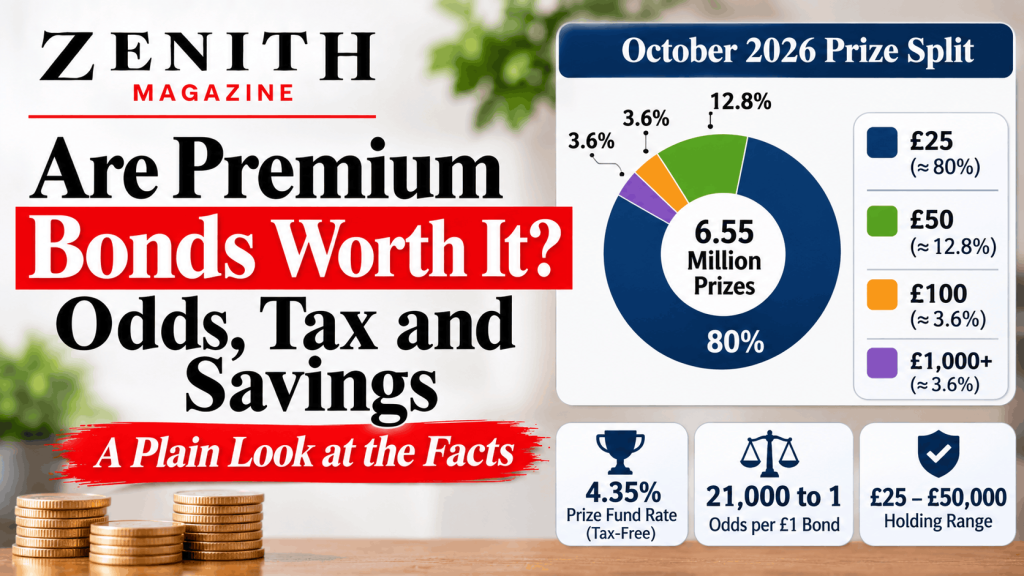
NS&I gives the odds of any £1 Bond winning a prize as 21,000 to 1 each month (October 2026 release, 1 October 2026). The October 2026 draw had 6,546,849 prizes worth £498,378,775 in total, with two £1 million jackpots.
The prize table is dominated by small prizes. Our calculation from NS&I’s October 2026 table is that £25, £50 and £100 prizes make up about 98.7% of all prizes: 1,721,281 prizes of £25, and 2,371,145 each of £50 and £100. NS&I’s allocation page says 80% of the prize fund goes to the lower band of prizes.
What is the average return on Premium Bonds?
The average is the prize fund rate: 4.35% for October 2026. We checked it ourselves: £498,378,775 a month, times 12, divided by the roughly 137.5 billion eligible £1 Bonds implied by the number of prizes and the odds, comes to 4.35%. That is our arithmetic, not an NS&I statement.
The key word is average. The NS&I brochure says your own return may be higher or lower than the rate because prizes are random. The next section gives a sense of how far apart outcomes can be.
Odds of winning Premium Bonds with 50000
A £50,000 holding is 50,000 Bond numbers. If each has a 1 in 21,000 chance each month (a simplification, and our own calculation):
- you would expect about 2.4 prizes a month, or about 28 to 29 a year;
- the chance of no prize in a given month is about 9%, so about a 91% chance of at least one;
- the chance of no prize at all across a whole year is vanishingly small;
- the chance of one of the two £1 million jackpots in a given month is about 1 in 1.4 million.
Probability of winning £25 on Premium Bonds
Of the 6,546,849 prizes in October 2026, 1,721,281 are £25 prizes (about 26%). On that basis, a single £1 Bond has roughly a 1 in 79,900 chance of a £25 prize in a month. With £50,000 held, we estimate about a 46% chance of at least one £25 prize in a given month. These are our calculations from NS&I’s table and the odds, not NS&I figures.
Why did I win nothing on Premium Bonds with max holding?
A month with no prize is not unusual even at the maximum: on our maths, roughly one month in eleven. A full year with nothing would be extraordinary. If you have not won for a long stretch, it is worth checking that your bonds and bank details are correct in your NS&I account or the Prize Checker, and for unclaimed prizes (see below). We cannot tell you why a particular holder has not won.
What percentage of people never win on Premium Bonds?
We found no current NS&I figure. Which? reported on 1 August 2024, citing an AJ Bell Freedom of Information request, that about two thirds of holders, just under 14.4 million of around 22.5 million people, had never won a prize. The same article said non-winners over the previous 12 months held an average of £175, against £23,047 for the 5.3 million who won between June 2023 and May 2024. That is a 2024 figure and may have changed.
How the average hides the typical outcome
To show how lumpy the outcomes are, we ran a simple simulation. It uses the October 2026 prize table, treats each £1 Bond as having an independent 1 in 21,000 chance each month, and simulates 100,000 years for each holding with the rate held fixed. It is our own model, not an NS&I tool, and results are rounded.
| Holding | Median year’s prizes as a % of the holding | Chance of no prize in a year | Chance the year’s prizes fall below 3.75% of the holding |
| £1,000 | about 0% | about 56% | about 65% |
| £5,000 | about 3.0% | about 6% | about 56% |
| £10,000 | about 3.5% | about 0.3% | about 53% |
| £25,000 | about 3.7% | effectively nil | about 52% |
| £50,000 | about 3.8% | effectively nil | about 47% |
The simulated averages came out at roughly 4.3%, in line with the 4.35% rate, but the median is lower because large prizes are rare and pull the average up. We use 3.75% as a reference point because that is NS&I’s Direct Saver rate (see below), not because anyone is guaranteed it. This is not a forecast.
Readers searching for a premium bonds calculator calculator tool should know that NS&I’s own tool, the Prize Checker (online or in the app), checks which prizes you have won, not what you are likely to win. The table above is an illustration, not a calculator.
Tax: what is and is not taxed
NS&I says Premium Bond prizes are free from UK Income Tax and Capital Gains Tax, which MoneyHelper repeats. That differs from interest on most savings accounts, which can be taxed above your allowances.
Do premium bond winnings count towards personal savings allowance?
We found no source that addresses this directly. The personal savings allowance (PSA) is an allowance for savings interest, and LITRG (updated 6 April 2026) gives it as £1,000 for basic-rate taxpayers. Our reasoning, which is not a quoted rule, is that tax-free prizes are not savings interest and so do not use the allowance. Check with HMRC if the question affects your tax return.
Here is where tax-free status can matter. If you would pay tax on interest from a savings account, then a tax-free return is worth more. Our arithmetic for the 4.35% rate, ignoring allowances:
| Taxpayer | Savings tax rate now (2026/27) | Gross rate needed to match 4.35% tax-free |
| Basic rate | 20% | 5.44% |
| Higher rate | 40% | 7.25% |
| Additional rate | 45% | 7.91% |
The government announced in November 2025 that savings income tax rates will rise from 6 April 2027 to 22% (basic), 42% (higher) and 47% (additional) (Gov.uk, 27 November 2025). At those rates, the matching gross figures would be about 5.58%, 7.50% and 8.21%. This only applies to interest that would actually be taxed: if your interest sits within your allowances, there is no tax to avoid.
Compared with savings
Premium bonds vs easy access savings account
| Premium Bonds | NS&I Direct Saver | Top easy access accounts (Moneyfacts, 30 October 2026) | |
| Rate | 4.35% prize fund rate, variable | 3.75% gross/AER, variable (NS&I, 18 August 2026) | 4.56% to 5.00% AER for the top three listed |
| Guaranteed? | No, depends on prizes | Rate is variable | Rate is variable, may include temporary bonuses |
| Tax | Prizes tax-free | Interest taxable | Interest taxable |
| Money back? | Yes, your stake | Yes | Yes |
Moneyfacts listed LemFi at 5.00% AER including a 1.89% bonus for six months, Oxbury Bank at 4.57% with no bonus, and Zopa at 4.56% including a 1.05% bonus for 12 months. Bonuses end, and rates can change at any time. NS&I’s Direct ISA was 3.80% tax-free on 18 August 2026.
The answer to “do Premium Bonds beat a savings account” depends on what you compare. The headline 4.35% beat NS&I’s own Direct Saver but not the top easy access rates on the day we checked. Once you consider that a typical holder gets less than the average, and that savings interest may be tax-free within your allowances, the comparison is closer to a trade-off than a win. We are not recommending either. MoneyHelper also says that unless you win a bigger prize, your return is unlikely to beat inflation.
Who might use them
MoneyHelper says Premium Bonds may suit you if you want a chance at tax-free prizes, can put in at least £25, and are buying for yourself or a child under 16. They may not suit you if you want regular income, guaranteed returns, or protection from inflation.
From the evidence above, our reading of when they might make sense (not advice):
- People who accept an uneven return in exchange for a chance of larger prizes.
- Savers who would pay tax on savings interest beyond their allowances, where tax-free matters more.
- Larger holders, because outcomes cluster closer to the average as the holding grows.
They are a weaker fit for small, short-term holdings where nothing is a likely result, or for anyone who needs predictable income.
Children, bereavement and lost Premium Bonds
Can a child keep Premium Bonds after turning 16?
Yes, the bonds stay theirs. NS&I’s product page says a parent or guardian looks after Bonds until the child’s 16th birthday, and the key features brochure says the child will then begin to manage their own Bonds at 16. We could not find what steps NS&I requires at 16, so contact NS&I. A child can hold up to £50,000 in total.
What happens to Premium Bonds when the holder dies?
NS&I says the Bonds can remain eligible for the draw for 12 months after the date of death in the holder’s name, but do not earn interest. Any prizes won are paid by warrant (like a cheque) to the person entitled once the claim is complete. The claim can start online with the bereavement form, and NS&I may ask for a Grant of Representation if the person’s NS&I savings total £5,000 or more.
How to track down lost or old Premium Bonds
NS&I says to start with your holder’s number if you have it (10 digits, 9 digits, or 8 digits followed by a letter), usually on your documents. If you do not have it, you can use the NS&I Tracing Service by completing an online form. You can search for someone else’s Bonds only if you are a parent or guardian of a child under 16, hold Power of Attorney, or are the executor.
For unclaimed prizes, NS&I says there is no time limit to claim, and they are paid by warrant, not directly to a bank account. You can check via your NS&I account, the online Prize Checker, the app, or by writing to NS&I.
Frequently Asked Questions
Do Premium Bonds beat a savings account?
Sometimes. The 4.35% prize fund rate (October 2026) beat NS&I’s Direct Saver at 3.75% but not the top easy access rates Moneyfacts listed on 30 October 2026. Your actual return depends on prizes, and tax-free only helps if savings interest would be taxed.
What is the average return on Premium Bonds?
The average is the prize fund rate, 4.35% tax-free for October 2026 according to NS&I. It is an average across all bonds. On our simulation, the typical £50,000 holder is nearer 3.8%, and small holdings often return nothing in a year.
Are Premium Bond prizes taxable?
No. NS&I says prizes are free from UK Income Tax and Capital Gains Tax. Tax-free prizes are not savings interest, so we would not expect them to use up your personal savings allowance, though we found no source saying so directly. Check with HMRC if unsure.
How likely is it to win nothing with the maximum holding?
On our calculation, about one month in eleven at £50,000, assuming a 1 in 21,000 chance per Bond each month. Going a full year without a prize would be extremely unlikely. If it happens, check your NS&I account details and unclaimed prizes.
Can I find Premium Bonds I have lost track of?
Yes. Use your holder’s number if you have it, or NS&I’s Tracing Service if you do not. NS&I says unclaimed prizes have no time limit, though they are paid by warrant. You can search for someone else’s Bonds only as a parent or guardian, attorney or executor.
What happens to Premium Bonds when someone dies?
They stay eligible for the draw for 12 months after the date of death but earn no interest, and prizes are held until the claim is complete. The estate can claim using NS&I’s bereavement process, and NS&I may ask for a Grant of Representation if the person’s NS&I savings total £5,000 or more.