Quick Answer
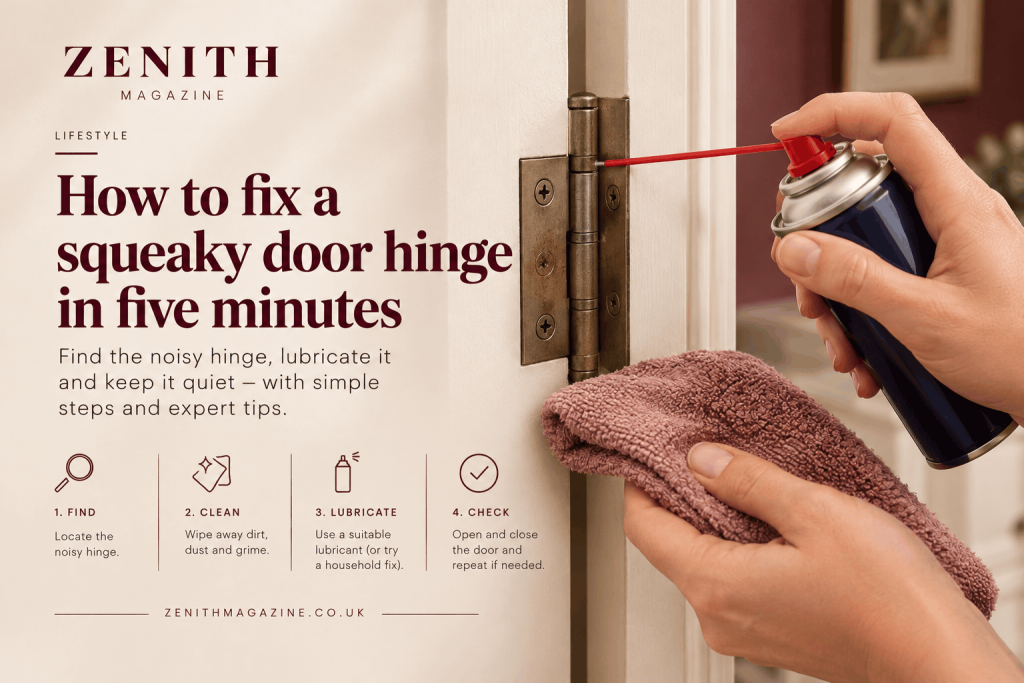
How to fix squeaky door hinges comes down to three steps: find the hinge that squeaks, wipe off the dirt and work a lubricant into the pin. Silicone spray or white lithium grease should last longer, while bar soap, petroleum jelly or olive oil is a quick fix. If the squeak keeps returning, the hinge may be loose, rusted or worn and need replacing.
Key Takeaways
- Work out which hinge is the culprit before you lubricate anything, and wipe off old grime first. Tightening loose screws is worth doing at the same time.
- Lubricants split into two groups: specialist products (silicone spray, white lithium grease) and household quick fixes (soap, petroleum jelly, olive oil, candle wax). The guides disagree on WD-40, so we set out both views below.
- Lubrication is a temporary fix. If a hinge is pinched, rusted out or the door is misaligned, no lubricant will cure it.
If you are searching for how to fix squeaky door hinges quickly, the short job is cleaning the hinge, adding a little lubricant and swinging the door a few times. It is not always a five-minute job: we have not timed any of these methods, and removing pins or soaking a rusty hinge takes longer. This guide covers the quick fix first, then pin removal, the choice of lubricant and when to give up and replace the hinge.
A note on sources: the advice comes from DIY and home-care guides, none of them a UK official body, and they do not always agree. We have not tested lubricants ourselves.
Find the noisy hinge
Why does my door squeak when I open it?
A squeak is metal rubbing on metal. The guides we read point to a few causes:
- Dirt, dust, grime or rust on the hinge, according to Tom’s Guide, which suggests checking the hinge for each of these and wiping it clean.
- A door that is not level. T3 says a squeak usually indicates the door is not level and is putting undue weight on the hinges.
- Loose screws. UK Oak Doors suggests tightening all the hinge screws while keeping the door aligned.
- A swollen door. Tom’s Guide lists a door swollen by water or humidity among the causes, and UK Oak Doors notes that humidity can make metal rust and wood swell.
How to find the squeaky hinge
Tom’s Guide says to make sure you know which hinge is the noisy one before you start. Open and close the door slowly and listen: most doors have two or three hinges, and often only one is guilty. The guides we read do not give a step-by-step method for this, so treat that tip as common sense, not a tested technique.
Once you know, check the hinge for rust and wipe it with a paper towel. Cleanipedia, a UK home-care site, also suggests cleaning old grease and grime off with an all-purpose cleaner, which it describes as potentially the quickest fix.
Lubricating without removing the pin
How to lubricate door hinges without removing the pin
You can do this with the door in place:
- Wipe the hinge with a rag or paper towel to clear away grime and grit.
- Hold a paper towel or rag under the hinge to catch drips.
- Apply your lubricant to the hinge pin and the seams. Schlage, the lock maker, suggests spraying in short bursts with the straw about an inch away.
- Open and close the door several times to work the lubricant in.
- Wipe off any excess and buff dry. Schlage warns that leftover moisture can cause rust.
Schlage also suggests tapping the pin so it sits slightly raised before spraying. That is a light version of pin removal and helps the lubricant reach inside the hinge.
Removing and cleaning the pin
How to remove a door hinge pin to lubricate
Removing the pin lets you coat the whole pin and the inside of the hinge. According to Tom’s Guide:
- Place a nail under the head of the pin at the bottom of the hinge and tap it gently. The pin should slowly pop up. Some hinges have the pin at the bottom, so you may have to reverse the process.
- Remove only one pin at a time. Do not take all the pins out at once, or the door will have nothing holding it in place.
- Reinsert the pin in the same direction it came out, tapping it with a hammer if needed.
iFixit takes a similar approach, using a flathead screwdriver in the crease between the pin and the hinge, tapping it out with a hammer, soaking the pin in mineral oil or another household lubricant, brushing oil on the empty hinge and refitting the pin. It notes that removal may take a while depending on the door.
UK Oak Doors adds that you can wash the pin and hinge in soapy water, scrub off rust with steel wool or a wire brush, and dry everything completely before lubricating and reassembling.
How to clean rusty door hinges
Hunker describes the full method for heavily rusted hinges: remove the door (with a helper if possible), scrub the hinges with coarse steel wool, use sandpaper if needed, then soak them in cola (it says several hours) or vinegar, rinse, wash in warm soapy water, and dry the hinges and pins completely. It warns that moisture trapped on the hinges can cause more rusting.
That is much more than five minutes, and it involves taking the door off, so save it for hinges that squeak and look rusty. Tom’s Guide says a hinge that is too rusted should be replaced.
Which lubricant for squeaky door hinges
Best lubricant for squeaky door hinges
There is no single winner in the guides we read, and we have not tested any. Bob Vila compares the main specialist options:
| Lubricant | What the guides say | Watch out for |
| Silicone spray | Lightweight, inexpensive, easy to apply, works in cold temperatures (Bob Vila) | Does not last as long as some alternatives and collects dust and dirt |
| White lithium grease | Thicker, lasts longer, copes with heat and does not collect dust as readily (Bob Vila). Tom’s Guide says “any lubricant like lithium grease should do the trick” | Tubes are harder to apply and messy, and cold weather can make it solidify |
| WD-40 | Schlage’s main recommendation, though it says the effect eventually dries up. Bob Vila lists WD-40 Specialist Silicone Lubricant as a silicone product | Tom’s Guide says it is “really meant to help get things unstuck” and “not a good long-term solution” |
| Graphite powder | Very effective at reducing friction (Bob Vila) | Extremely messy and can stain carpets and woodwork |
The WD-40 advice conflicts, and the brand sells more than one product, so check what is on the can you are holding. Whatever you choose, Bob Vila says too much lubricant is rarely the answer, because the excess attracts dust, dirt and lint, and overspray on woodwork can affect paint adhesion. Keep a rag handy.
Silicone spray for door hinges
Silicone spray is the easy option for most people: a small can with a straw that you can aim at the pin. Bob Vila likes it for being cheap and cold-tolerant but warns it collects dust and dirt over time.
White lithium grease for squeaky doors
White lithium grease is thicker and, according to Bob Vila, lasts longer and copes with heat. It comes in tubes or spray cans. For a hinge with the pin removed, a small smear on the pin is easy to control.
How to stop a door from squeaking without WD40
You have two routes. Use a specialist product such as silicone spray or white lithium grease, or use a household item from the next section. Tom’s Guide also mentions any petroleum-based spray as a quick alternative to WD-40, and spray-on deodorant “in a pinch”.
Squeaky door fix household items
These come from T3, Schlage, Cleanipedia and Mod Lighting. None of the guides measure how long they last, and Schlage describes lubrication in general as a temporary fix.
| Household item | How the guides use it |
| Bar soap | Rub it on the hinge until coated, open and close the door, wipe off the excess (T3, Schlage) |
| Petroleum jelly | Rub a little on the outside of the hinge and work it in, or coat the removed pin (T3, Schlage, Mod Lighting) |
| Olive oil | A few drops from a pipette or a cotton swab (T3, Schlage, Cleanipedia) |
| Washing-up liquid | A small amount on the hinge, then swing the door (T3) |
| Paraffin candle wax | Rub hot wax onto a removed pin and reinsert it (Schlage) |
| Hairspray | A few sprays, then swing the door until it dries. Mod Lighting calls it a short-term fix |
| Butter | Rub on the hinge pin (Cleanipedia) |
Aim the product at the hinge and keep it off the door and floor. Schlage advises concentrating on the hinges and cleaning up any overapplication.
Using bar soap for squeaky doors
Using bar soap for squeaky doors is the simplest household fix because there is nothing to drip. T3 suggests a soap with a higher fat content, or an organic soap, rubbed on until the hinge is coated, then wiped with a damp cloth.
How to fix a squeaky door with vaseline
To fix a squeaky door with Vaseline (petroleum jelly), rub a small amount on the outside of the hinge until it seeps in. For a more thorough job, T3 and Schlage both say to remove the pin, coat it and put it back. Mod Lighting calls petroleum jelly its most recommended household option.
How to fix a squeaky door with olive oil
To fix a squeaky door with olive oil, use a pipette or cotton swab to add a few drops to the hinge. T3 recommends a pipette or small oil can to stop it going over the floor. No guide says how long the effect lasts.
Paraffin wax for squeaky door hinges
Paraffin wax for squeaky door hinges is meant for a removed pin. Schlage says to rub hot wax onto the pin before reinserting it. Mod Lighting says you may need to light the candle first so the wax softens.
Hairspray for squeaky doors hack
The hairspray for squeaky doors hack is quick: a few sprays on the hinge, then swing the door until it dries. Mod Lighting calls it a short-term fix and gives no other cautions.
Fixing squeaky door hinges with baby powder
We did not find a reputable guide that tests or recommends fixing squeaky door hinges with baby powder, so we cannot say whether it works. If you want a dry option, Bob Vila covers graphite powder instead, with the warning that it is messy.
How to fix a squeaky door hinge permanently
No guide we read claims a lubricant is permanent. Schlage calls lubrication a temporary fix, though the easiest and most cost-effective one for most squeaks, and says no lubricant can revive a hinge that is pinched or rusted out. The longer-lasting steps are the other ones: tighten loose screws, realign the door, clean off rust, and replace the hinge if it is worn. In damp rooms, UK Oak Doors suggests a dehumidifier to reduce the humidity that causes rust and swelling.
Squeaks on other doors
How to stop a car door from squeaking
YourMechanic says to open and close the door several times to confirm where the noise comes from, and names three likely culprits: the hinges, the rubber seals and the door check (the part that holds the door to the frame). Clean those areas first with a household cleaner, or an automotive cleaner for heavy build-up, then lubricate. NAPA suggests a multi-purpose automotive lubricant spray, and advises against powdered graphite because it may not reach into all the gaps. YourMechanic warns that certain lubricants may not suit all materials, and that heavily rusted hinges must be replaced.
Squeaky cabinet door hinge fix
We did not find a source that deals specifically with cabinet hinges. The general advice still applies: clean the hinge, use a small amount of lubricant and keep it off the door, since Bob Vila warns about overspray on painted wood. T3 notes that hinge types are not interchangeable, and that the hinge on a gate is not usually the one used on a cupboard, so identify the type before buying a replacement.
When to replace the hinge
Replace the hinge if:
- the squeak comes back really quickly after lubricating (Cleanipedia);
- it is pinched or rusted out, because no amount of lubricant can revive it (Schlage);
- it is too old or worn to repair (UK Oak Doors), or too rusted (Tom’s Guide).
For a replacement, UK Oak Doors says to buy hinges of the matching size and type, unscrew the old ones, fit and screw in the new ones, then check and adjust the alignment. If the door is a fire door, check the manufacturer’s or installer’s guidance before swapping hinges; we did not research fire door requirements.
Frequently Asked Questions
What stops a door hinge squeaking?
Cleaning the hinge and adding a lubricant to the pin. Specialist options such as silicone spray or white lithium grease last longer, while soap, petroleum jelly and olive oil are quick household fixes. Open and close the door to spread it, and wipe off the excess.
Can you fix a squeaky door hinge without removing the pin?
Yes. Clean the hinge, apply lubricant to the pin and seams, then swing the door several times. Schlage suggests tapping the pin slightly raised first so the lubricant gets inside. Removing the pin is more thorough but not essential for a light squeak.
What household items fix a squeaky door?
Bar soap, petroleum jelly (Vaseline), olive oil, washing-up liquid, paraffin candle wax and hairspray are all suggested by home guides. They are quick fixes with no measured lifespan. Apply them to the hinge only and wipe off excess.
Is WD-40 good for squeaky hinges?
The guides disagree. Schlage recommends it, though it says the effect dries up eventually. Tom’s Guide says WD-40 is meant to free stuck parts and is not a good long-term solution. Silicone spray or white lithium grease may last longer.
How do you stop a squeaky hinge permanently?
No guide claims a lubricant is permanent. For a longer-lasting fix, clean off rust, tighten loose screws, check the door is level, and reduce humidity in damp rooms. If the hinge is pinched, rusted out or worn, replace it.
When should you replace a squeaky hinge?
When the squeak returns quickly after lubricating, or the hinge is rusted, pinched or worn. Match the size and type of the old hinge, because types are not interchangeable. Check the door’s alignment once the new hinge is fitted.