
Quick Answer
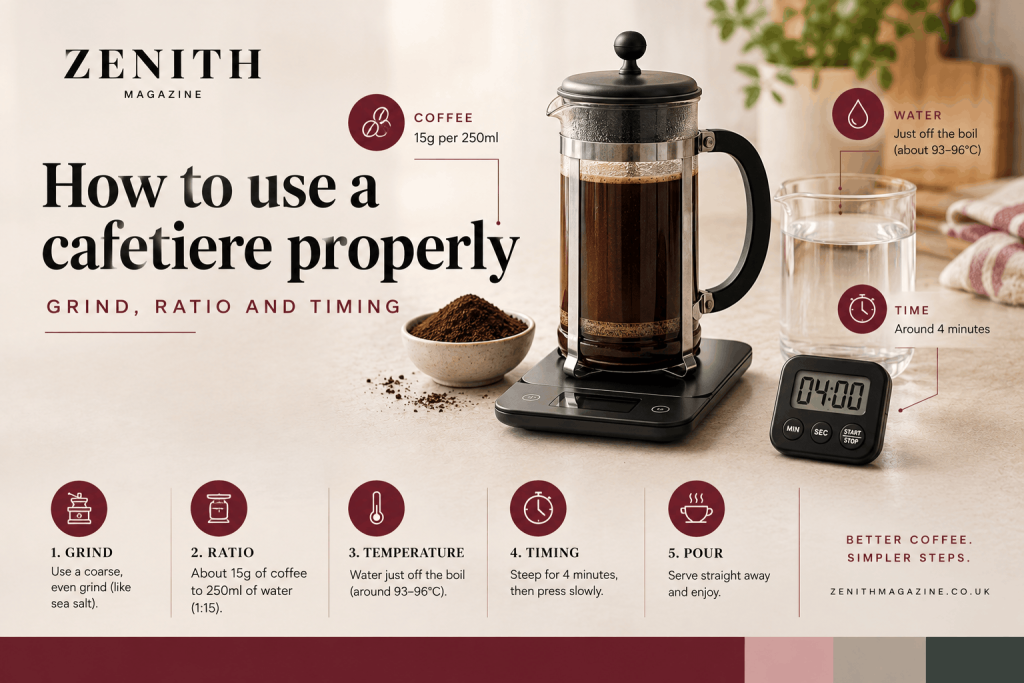
Use coarse, even grounds at roughly 15g of coffee to 250ml of water, add water just off the boil, stir and leave it for about four minutes. Press the plunger down slowly, then pour straight away. Watery coffee usually means the grind is too coarse, the dose too small or the water too cool. Roasters’ recipes differ in detail, so treat these figures as a starting point.
Key Takeaways
- Weigh your coffee if you can. The roasters and retailers we read agree on a ratio of about 1:15 to 1:17, which works out at 15g of coffee per 250ml of water, but a tablespoon of coffee can weigh very different amounts.
- Grind and time work together. Too coarse or too short gives thin, sour coffee, and too fine or too long gives bitter, muddy coffee.
- Pour the coffee out as soon as you plunge. Coffee left on the grounds keeps extracting, and sources recommend decanting what you will not drink straight away.
How to use a cafetiere: what you need
How to use a cafetiere comes down to five things: a cafetiere, coffee, hot water, a spoon and a timer. A pair of scales helps, because coffee is easier to measure by weight than by spoon. A cafetiere is also called a French press or a coffee plunger. It is a jug with a plunger that holds a metal mesh filter, and it brews by steeping the grounds in the water, then pressing the filter down to hold them at the bottom.
The mesh filter is the reason for the grind advice that follows. Redber, a UK coffee retailer, explains that the metal mesh lets finer particles through, which causes sediment and a harsh taste.
Cafetiere grind: the best grind size for cafetiere coffee
The best grind size for cafetiere coffee is a coarse, even one. Extract Coffee Roasters describe it as like sea salt, and Redber says coarse sea salt. Iron & Fire says relatively coarse, slightly finer than rock salt. If you buy pre-ground coffee, choose the cafetiere option on the bag.
French press grind size
The French press grind size is the same thing under another name, so the advice above applies. There is one dissenting view. James Hoffmann’s well-known method, as described on two coffee blogs, uses a grind finer than most people would normally use, then a longer wait for the sediment to settle. We cover it below.
How to tell if the grind is wrong
RAVE Coffee, a UK roaster, gives a useful test: if the plunger drops with no resistance, the grind is too coarse. If it is very hard to push, it is too fine. Extract’s troubleshooting is the same in taste terms: a coarser grind for bitter or sludgy coffee, a finer one for watery, sour or thin coffee.
Cafetiere coffee to water ratio: how much coffee to put in a cafetiere
How much coffee to put in a cafetiere depends on the size of the pot and how strong you like it. The sources we read are close together:
| Source | Ratio or dose |
| Extract Coffee Roasters | 1g of coffee to 15ml of water; 33 to 35g for a 500ml cafetiere |
| RAVE Coffee | 15g per 250ml as a general rule (1:16 elsewhere on the page) |
| Iron & Fire | 1:14 to 1:18; 15g for 250ml, 30g for 500ml, 60g for 1 litre |
| Hoffmann method (via Coffee Works) | About 60g per litre |
The cafetiere coffee to water ratio of 15g to 250ml sits in the middle of all of them. Scale it like this (our arithmetic, based on 60g per litre):
| Water | Coffee |
| 250ml (one mug) | 15g |
| 500ml | 30g |
| 750ml | 45g |
| 1 litre | 60g |
How to use a cafetiere for one person
For one mug, use about 15g of coffee and 250ml of water. Whittard’s guide says a 3-cup cafetiere makes one mug, but its “cup” is an espresso cup, so check the capacity printed on your pot rather than counting cups.
Tablespoons of coffee per cafetiere
Tablespoons of coffee per cafetiere vary, which is why we prefer scales. Redber says one tablespoon of ground coffee per cup of water. Whittard says one scoop per cup. Extract suggests about one heaped dessert spoon (around 7g) per 100ml. They do not agree, because the weight of a spoonful depends on the roast, the grind and the spoon. We found no source that converts the weight to spoons reliably. If you have scales, weigh 15g once, see how many of your spoons it takes, and use that.
Step by step cafetiere instructions
Step by step cafetiere instructions, drawing on the roasters’ guides above:
- Warm the pot. RAVE suggests rinsing the cafetiere with boiling water, then discarding it.
- Weigh and grind the coffee. About 15g per 250ml, coarse and even.
- Boil the kettle and wait a moment. RAVE leaves the lid open for about a minute to reach 93 to 94°C.
- Pour the water over the grounds gently, making sure all of them are wet. Start a timer.
- Stir. Extract stirs straight after pouring, then breaks the crust of floating grounds at four minutes.
- Put the lid on and leave it to steep for about four minutes.
- Plunge slowly, then pour straight away.
Cafetiere water temperature Celsius
The cafetiere water temperature Celsius figure is a range: RAVE aims for 93 to 94°C and Redber says 92 to 96°C. Both are above what most people get from a kettle left to cool, so roughly a minute after boiling is a practical rule, which is our reading of RAVE’s advice. Iron & Fire takes a more relaxed view: boiling water will not burn the coffee, though it may add a few more bitter notes. Whittard says to let freshly boiled water cool slightly.
How long to leave coffee in a cafetiere before plunging
Cafetiere brewing time minutes: four, according to Extract, RAVE, Redber and Whittard, whose guide says no longer than four. Iron & Fire gives three to four minutes, and says some coffees can go longer. Redber adds that longer steeping leads to bitterness from over-extraction.
Hoffmann’s method, as described by Coffee Works and the Coffee Blog, is a different idea: steep for four minutes, stir, skim off the floating grounds, then wait about five more minutes without plunging, so that more of the fine particles settle. The Coffee Blog author reported much less sediment than with a standard brew, based on one try, and the total is nine minutes. It is worth trying if sludge is your main complaint.
How to plunge a cafetiere smoothly, and how to pour
How to plunge a cafetiere smoothly: press slowly and steadily, with only slight resistance. Extract says to press slowly with little resistance, and to press only halfway if you want less sludge. Iron & Fire says not to press all the way down, but just low enough to hold back some grounds. If it will not move, the grind is probably too fine, and if it drops straight down, too coarse.
Then pour. Extract says to serve immediately. If you will not drink it all at once, Coffee Works recommends decanting it into a well-insulated flask or carafe, which stops the coffee over-extracting and turning bitter in the pot.
That is how to use a coffee plunger properly, and it is the main difference between smooth cafetiere coffee and a harsh cup.
Making smooth cafetiere coffee: what tastes different
Making smooth cafetiere coffee is mostly a matter of avoiding the things the sources warn about. A coarse, even grind keeps sediment down. Four minutes is long enough to extract without turning bitter. Skimming the crust, plunging gently and decanting leave less sludge in the cup.
We did not run our own grind comparison for this article, so we cannot report a taste test. Here is how the sources describe the differences:
| Change | What the sources say happens |
| Finer grind | More extraction: Hoffmann’s method uses it with a longer settle to deal with the extra fines. Extract says use a finer grind if coffee is watery or sour |
| Coarser grind | Less extraction: thin or slightly sour if too coarse (Redber); less bitter and sludgy (Extract) |
| Longer steep | More bitterness (Redber) |
| Hotter water | More bitter notes (Iron & Fire; Redber) |
Why is my cafetiere coffee watery?
Why is my cafetiere coffee watery? Redber gives two causes: a grind that is too coarse, which leads to under-extraction and weak coffee, and water that is too cool. Extract’s troubleshooting adds a third and fourth: too small a dose, and too short a brew. Use this as a checklist, changing one thing at a time:
- Is the dose about 15g per 250ml? If you measure by spoon, weigh it once.
- Is the grind coarse but even, and does the plunger meet some resistance?
- Was the water just off the boil, not left to go lukewarm?
- Did it steep for about four minutes?
If the coffee is watery, sour or thin, Extract’s advice is to use a finer grind, or, if you cannot change the grind, lengthen the brew, increase the dose or stir more often.
Best coffee beans for cafetiere
The best coffee beans for cafetiere brewing are a matter of taste, but Redber’s guide recommends a medium or medium-dark roast with a coarse, even grind for sweetness and body without bitterness. It suggests lighter roasts for a brighter, fruitier cup and darker roasts for stronger flavour or for adding milk, with a warning not to brew them too long. Balance Coffee, a UK roaster, says freshness and a coarse grind matter more than the label, and that espresso blends can work well. Those are retailers’ and roasters’ opinions, not tested results, so treat them as a guide.
How to clean a cafetiere properly
How to clean a cafetiere properly, using the steps in the Maxicoffee and Homes & Gardens guides:
- Bin the grounds, not the sink. Put them in a food waste bin or compost. Maxicoffee warns that they can block the drain.
- Take it apart. Remove the plunger and the mesh filter from the jug. Maxicoffee suggests using a wooden or plastic spoon, not a metal one, to remove stuck grounds, because metal will scratch.
- Wash each part. Scrub the filter on both sides with a soft brush or sponge, and wash the jug in warm, mild soapy water. Check any rubber or silicone seals for residue.
- Rinse and air dry completely before reassembling.
A deep clean every few weeks keeps it fresh. Maxicoffee suggests soaking the parts overnight in equal parts water and white vinegar. Homes & Gardens suggests a weaker mix of four parts water to one part vinegar for a few hours or overnight, or one tablespoon of baking soda in a cup of hot water left for at least 30 minutes. The two guides disagree on the vinegar strength, so start with the weaker one.
On the dishwasher, Maxicoffee advises against it, especially for glass or wooden handles. Some stainless steel models may be dishwasher-safe, so check the maker’s instructions.
Frequently Asked Questions
What is the right way to make coffee in a cafetiere?
Use coarse, even grounds at about 15g per 250ml of water, add water just off the boil and stir. Leave it for about four minutes, press the plunger down slowly, and pour straight away. Adjust the grind, dose and time to taste.
How much coffee to put in a cafetiere?
A good starting point is 15g of coffee per 250ml of water, which scales to 30g for 500ml and 60g for a litre. Spoon sizes vary, so weigh it once if you can. Make it stronger or weaker by changing the dose.
How long to leave coffee in a cafetiere before plunging?
About four minutes, according to Extract, RAVE and Redber. Iron & Fire says three to four. Longer steeping can make the coffee bitter. Hoffmann’s method adds a five-minute settle without plunging, which some people find reduces sediment.
Why is my cafetiere coffee watery?
The usual causes are a grind that is too coarse, too little coffee, water that is too cool or a brew that is too short. Weigh about 15g per 250ml, use a finer grind if needed and steep for about four minutes.
What is the best grind size for cafetiere coffee?
Coarse and even, like sea salt, according to Extract and Redber. Iron & Fire says slightly finer than rock salt. If the plunger drops without resistance it is too coarse, and if it is very hard to push it is too fine.
How to clean a cafetiere properly?
Put the grounds in the food waste bin, not the sink. Take the cafetiere apart, wash each part in warm soapy water, rinse and air dry fully. Do a vinegar or baking soda soak every few weeks, and avoid the dishwasher for glass.