
Quick Answer
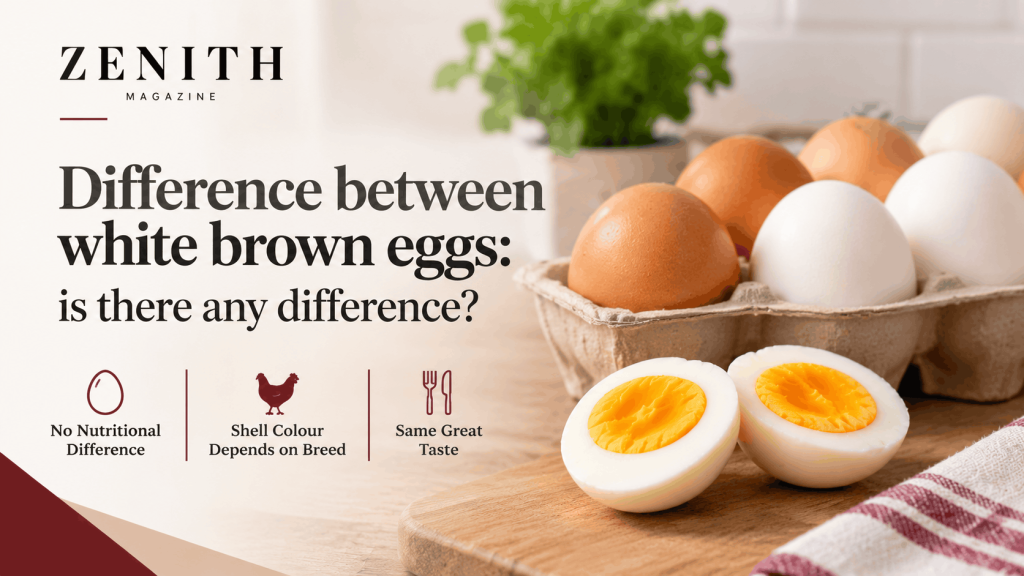
No. Shell colour depends on the breed of hen, and British Lion eggs says there is no nutritional difference between brown and white eggs and no scientific difference in taste. What can differ is the hen’s feed and how she is kept, and the number stamped on the shell tells you the farming method.
Key Takeaways
- Shell colour is a breed trait. It says nothing about nutrition, freshness or welfare.
- The number at the start of the stamp on the shell is what shows how the hens were kept: 0 organic, 1 free range, 2 barn and 3 cage.
- Prices, yolk colour and shell strength are driven by feed, hen age and farming method, not by whether the shell is brown or white.
Difference white brown eggs: why shell colours differ
The difference white brown eggs show on the shelf is mostly one of colour. British Lion eggs, the egg industry’s food safety scheme, says that the colour of the shell depends on the breed of the hen: in general, white hens lay white eggs and brown hens lay brown ones.
The pigment is added late. RSPCA Assured explains that the colour comes from pigments added to the shell in the final stages of egg formation inside the hen. Other sources say all eggs start out white. A brown pigment is added mainly to the outer surface of the shell, whereas the blue pigment of blue-egg breeds goes right through it.
A hen does not change colour. RSPCA Assured says a hen will lay the same shell colour all her life, though shells can become slightly lighter as she ages.
Chicken breeds egg color
Which breeds lay what? A Texas A&M AgriLife Extension list gives these examples:
| Egg colour | Example breeds |
| White | Leghorn, Minorca, Andalusian, Ancona |
| Brown | Rhode Island Red, Plymouth Rock, New Hampshire, Orpington, Sussex |
| Very dark brown | Langshan, Marans (Marans are described elsewhere as laying dark brown eggs) |
| Blue to green | Araucana |
A rule of thumb from the same Extension service and from RSPCA Assured is that hens with white feathers and white earlobes lay white eggs, and hens with red or brown feathers and red earlobes lay brown eggs. It works for the common commercial breeds but not for every breed.
British Lion eggs adds that until fairly recently the British industry produced almost 100 per cent brown-shelled eggs, but white eggs are becoming more common again. Both colours can be produced to British Lion standards and both carry the red Lion mark.
Nutrition and taste: brown vs white eggs nutrition
Brown vs white eggs nutrition
British Lion eggs says there are no nutritional differences between brown and white eggs, including protein. RSPCA Assured agrees that shell colour has no influence on nutritional value, and it does not affect freshness, food safety or overall egg quality.
Nutritional difference in chicken eggs
There can be differences between eggs, but they come from elsewhere. Egg Farmers of Canada says brown and white eggs are nutritionally identical unless the hen’s feed has been enhanced for speciality eggs, such as omega-3. Egg size also affects the amount of nutrients you get. Neither depends on shell colour.
Brown eggs health benefits myth
Why do people believe in it? Many shoppers began to favour brown eggs, often believing they were more natural or higher quality, RSPCA Assured notes, even though colour has no impact on nutrition, taste or welfare. A Wageningen University researcher offers another reason: free-range eggs used to be brown, so people linked the colour with a healthier egg, but free-range eggs can be white too.
White vs brown eggs taste
Do brown eggs taste different than white eggs? British Lion eggs says that while some consumers may believe one colour tastes better, there is no difference from a scientific perspective. RSPCA Assured says there is no evidence that shell colour affects flavour.
Yolk color white vs brown eggs
Yolk colour is a separate question. RSPCA Assured says it is largely determined by what the hen eats. A New Zealand egg producers’ page adds that hens eating plenty of yellow-orange plant pigments lay deeper yolks, while those eating wheat or barley lay lighter ones. That is a diet effect, not a shell colour effect.
Shell thickness brown vs white eggs
Shell colour does not determine thickness. University of Kentucky extension teaching slides state that shell colour does not affect egg quality, cooking characteristics, nutritive value or shell thickness. Canadian Food Focus explains that as a hen ages she lays larger eggs but deposits the same amount of calcium, so older hens lay thinner shells. RSPCA Assured adds that welfare can influence shell quality and the hen’s overall health, though not colour. Those two sources are not UK-based.
White eggs vs brown eggs baking
Colour makes no difference to cooking. The same University of Kentucky slides say shell colour does not affect cooking characteristics. What matters for baking is egg size, and Canadian Food Focus notes that eggs are sorted by weight and most recipes call for large eggs.
Brown eggs vs white eggs cost: why they differ
Brown eggs often cost more, and the explanation given is about the hen. A Wageningen University poultry researcher says white hens are slightly smaller than brown hens and therefore need less feed to produce an egg. Eat This, Not That, quoting a US dietitian, says brown-egg breeds tend to be larger, need more food, space and care, and lay fewer eggs.
We did not find UK price data, and price also reflects the farming method, so a brown free-range egg will often cost more than a white caged one for that reason alone. That last point is our interpretation.
What the code on the shell means
Hens’ eggs sold by retailers in the UK must carry a stamp. According to Trading Standards guidance on Business Companion, it states the farming method, the country of origin and a production site code. A typical egg might be stamped 3UK12345:
| Part of the stamp | Example | Meaning |
| First digit | 3 | Farming method: 0 organic, 1 free range, 2 barn, 3 cage |
| Letters | UK | Country of origin |
| Number | 12345 | Production site code |
Eggs not produced to the free-range or barn methods are automatically classed as eggs from caged hens. In Northern Ireland the production site number is preceded by a 9, according to the Department of Agriculture, Environment and Rural Affairs (DAERA).
The red Lion mark is a separate thing. It marks eggs produced to the British Lion food safety standards, including hens vaccinated against Salmonella. British Lion eggs says all of its eggs, white or brown, are approved by the Food Standards Agency to be eaten runny by vulnerable groups. For more on keeping cooked eggs safely, see our guide to how long boiled eggs keep in the fridge.
Free range, barn and organic: what the wording means
RSPCA Assured says it inspects egg-laying hens kept in organic, free-range and barn systems and does not allow hens to be kept in cages of any type. It says the old battery cage was banned in Europe in 2012 and replaced by the colony, or enriched, cage, which is still a cage system.
Compassion in World Farming says the British Lion scheme has generally ensured only minimum legal welfare requirements and permits enriched cages. It adds that a higher-welfare barn standard from 2019 prohibits some intensive systems and that a 2023 code adds requirements, but enriched cages are still allowed. That page may be out of date, so check the current Lion Code before quoting it.
Are brown eggs cage free?
Colour does not tell you. RSPCA Assured says welfare does not affect egg colour, so a brown egg can come from any system. Check the first digit of the stamp: 3 means cage. Free-range eggs can be white as well as brown.
Free-range labels and bird flu
Rules can change during bird flu housing orders. In February 2023, RSPCA Assured said eggs from free-range birds that were being housed had to be labelled as barn. Check the box if you are buying during an outbreak.
Which eggs to buy
Put the shell colour last. A short checklist:
- The stamp: the first digit shows the farming method.
- The red Lion mark: shows British Lion food safety standards, if that matters to you.
- Welfare marks: RSPCA Assured inspects organic, free-range and barn farms.
- The date and size: check the date, and the size if you are baking.
- Price: white eggs are often cheaper, but compare on farming method too.
- Environment: the Wageningen researcher notes that white eggs are slightly more climate-friendly because the hens eat less. That is one expert’s view.
Frequently Asked Questions
Are brown eggs healthier or tastier than white ones?
No. British Lion eggs says there is no nutritional difference between brown and white eggs and no scientific difference in taste. Shell colour reflects the hen’s breed. Feed and farming method matter more, and the stamp on the shell shows the method.
Why are brown eggs more expensive than white eggs?
The usual explanation is the hen, not the egg. A Wageningen University researcher says white hens are slightly smaller and need less feed per egg. Price also depends on the farming method, so compare the stamp as well as the colour.
Are brown eggs organic?
Not necessarily. Colour has nothing to do with it. In the UK, organic eggs carry a 0 at the start of the stamp, such as 0UK12345, whatever the shell colour. Look for the 0, not the brown shell.
What breed of chicken lays brown eggs?
Common breeds include the Rhode Island Red, Plymouth Rock, New Hampshire, Orpington and Sussex, according to a Texas A&M AgriLife Extension list. Marans lay very dark brown eggs. A hen with red feathers and red earlobes usually lays brown eggs.
Why do some chickens lay white eggs and others brown?
Breed. British Lion eggs says shell colour depends on the hen’s breed. Brown-egg breeds add a pigment to the outside of the shell in the last stage of formation, while white-egg breeds such as the Leghorn do not.
What is the difference between brown and white eggs health benefits?
There is none. RSPCA Assured says shell colour has no influence on nutritional value. Differences arise from feed, such as omega-3 enriched diets, and egg size, not from whether the shell is brown or white.