Quick Answer
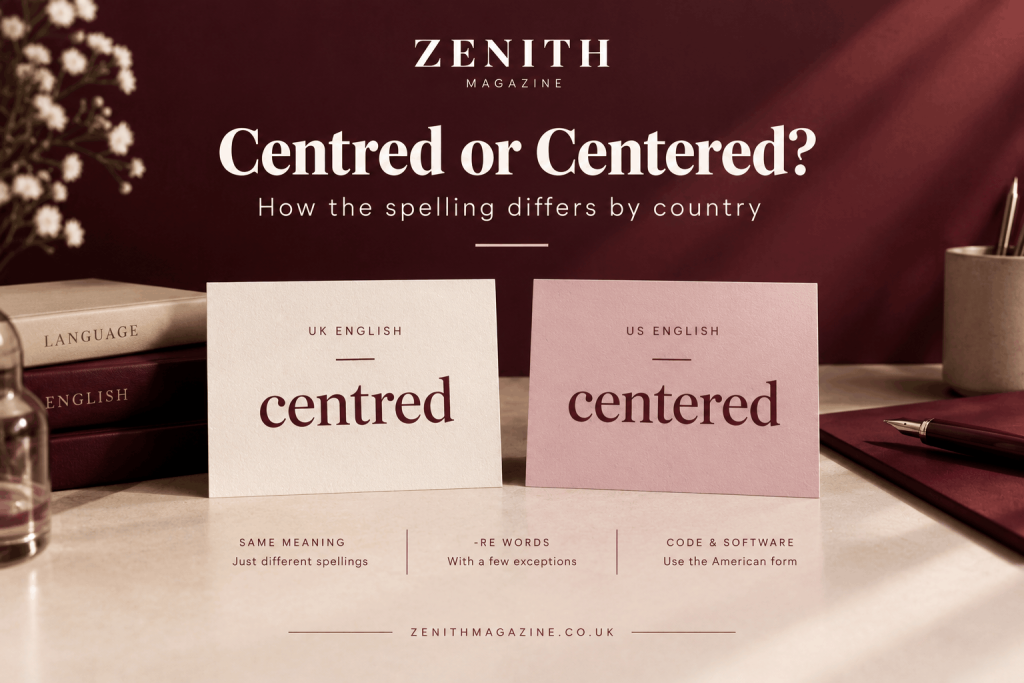
Centered or centred? Centred is the British spelling and centered is the American one, and both mean the same thing. The split follows centre and center, and centring and centering. In UK prose, write centred. In code, use the American form, because CSS text-align accepts center and does not list centre as a value.
Key Takeaways
- The difference is regional spelling only. Centre, centred and centring are British. Center, centered and centering are American.
- Software often uses American spellings in its code and help text, even for UK users. Your document can say centred while your stylesheet says center.
- A few -re words, such as acre, genre and massacre, keep their ending in American English too, so the -re rule is a pattern with exceptions.
Centered or centred? UK and US spellings
In British English the noun is centre, and its verb forms are centres, centring and centred. In American English they are center, centers, centering and centered. Collins lists centred as the British spelling and notes “(US) centered”. Merriam-Webster calls centre a “chiefly British spelling of center”.
Nothing else changes. A heading that is centred in a UK magazine is the same heading that is centered in a US one.
What is the difference between centered and centred?
Only the spelling. The two forms are variants of one word, so neither is a mistake in its own country. The correct choice depends on who you are writing for, and on being consistent within one document.
Centered or centred which is correct? A UK answer
For UK readers, centred is correct. Centered is not wrong in the sense of being invented, but it reads as American in a British publication. If you are writing for an American audience, use centered.
The meaning of centred in English
Collins gives two main senses for centred. As an adjective it describes someone who is mentally and emotionally steady, with confidence, focus and balance. As the past form of the verb centre, it can also mean placed in the middle, or having something as its main theme, as in Collins’s example “the novel centred on crime”.
Centered vs centred definition: what the verb means
Cambridge Dictionary gives the transitive verb centre as “to put something in the middle of an area”, with the example of placing headings centrally on a page. That is the sense most writers mean when they talk about centred text.
Other -re words: theatre, metre, fibre
Centre belongs to a family of words where British English prefers -re and American English prefers -er. Massey University’s writing guide lists five typical pairs:
| British | American |
| centre | center |
| metre | meter |
| litre | liter |
| theatre | theater |
| fibre | fiber |
LanguageTool adds calibre and caliber to the group. It also says the pattern carries into verb forms: centres, centring and centred in British English, against centers, centering and centered in American English.
Massey’s guide says the American -er forms are “usually” used, which signals that the rule has gaps. LanguageTool goes further on one word: it says theatre and center “seem to vary in both standard languages”, so the best choice depends on your reference.
Metre or meter in British English
In British English, a common convention is that metre is the unit of length and meter is a measuring device, such as a gas meter. That distinction is widely taught, but we did not check it against a dictionary for this article, so confirm it before relying on it in print.
Exceptions: -re words that stay as they are
LanguageTool lists acre, cadre, genre, lucre, macabre, maître, massacre, mediocre and oeuvre as words spelled with -re in both British and American English. A writer who turns every -re into -er would get these wrong.
Proper names are another exception. LanguageTool’s example is the Scottish Exhibition and Conference Centre, which keeps its -re. The article says the name giver decides which convention applies, so a name should be copied as written, whichever side of the Atlantic you are on.
Software settings: spelling in code and menus
The word you write in a document and the word a program expects are not always the same.
CSS text align center vs centred syntax error: use the American keyword
The Mozilla Developer Network lists the text-align keywords as start, end, left, right, center, justify and match-parent, plus a few non-standard and global values. Centre is not among them, and the page does not mention it.
MDN’s page does not describe what happens if you type centre. Under CSS’s general error handling, an unrecognised value makes the whole declaration invalid, and the browser ignores it. That is general CSS behaviour, not something the page says, so test it in your target browsers. The practical rule is simple: write center in a stylesheet, even if the page itself is in British English.
Adobe InDesign paragraph alignment center spelling: what the buttons say
Adobe’s English InDesign help page uses the American spelling. It lists the paragraph alignment buttons as Align Left, Align Center, Align Right, Left Justify, Center Justify, Right Justify and Full Justify. We did not check how a UK-localised interface labels these buttons, so look at your own screen before you write instructions for colleagues.
Typesetting rules centering or centring text block: the British forms
British writers who describe the act of centring a block of text use centring, matching the verb forms LanguageTool gives. The spelling in a style guide or tutorial should follow the same variety as the rest of the document.
We did not find a typesetting rule that settles the spelling. What we can say is that the choice follows the language variety, not the trade.
Word processor alignment tool centered formatting: Word and others
A UK guide from Digital Unite calls the Word button the “centre text” icon and gives Ctrl and E as the shortcut, with the instruction “To make text centred, select and highlight the text first”. That page was last updated on 3 June 2019, so check the current Word interface if you need to match it exactly.
Web typography centered headers vs left aligned body text
Centred headings are a design choice, not a spelling question. For paragraphs, the University of Newcastle’s accessibility guidance recommends that they be left aligned rather than “fully justified, centred or right aligned”. The page does not give advice on headings, so we have no accessibility rule to quote for them.
Quick guide: which spelling to use
| Where you are writing | Use | Why |
| UK articles, emails and essays | centre, centred, centring | British spelling |
| US articles and emails | center, centered, centering | American spelling |
| CSS text-align | center | The keyword MDN lists |
| A product or building name | As the owner writes it | LanguageTool: the name giver decides |
| Words such as genre and acre | Keep -re | -re in both varieties |
If you edit someone else’s work, a spell checker set to British English will usually flag centered. It will not know whether the company that owns the name chose the American form.
Frequently Asked Questions
Is it centred or centered in the UK?
Centred. British English uses centre, centres, centring and centred. Centered is the American form. Both mean the same, but a UK publication should use centred consistently, unless it is quoting a name or a piece of code that uses the American spelling.
Do centred and centered mean different things?
No. They are the British and American spellings of the same past form of the verb. Collins and Cambridge give the same senses: put in the middle, or, for centred, focused on a theme or emotionally steady. The only difference is regional spelling.
Should I write centre or center in CSS?
Write center. MDN lists center as the text-align keyword and does not mention centre. Typing centre will most likely be ignored by the browser, though MDN does not say so, so test it. The spelling in your page text can still be British.
Is it centring or centering?
Centring is British and centering is American. LanguageTool lists centres, centring and centred as the British set and centers, centering and centered as the American one. Use the set that matches the rest of your document.
Which other words end in -re in British English?
Common pairs include theatre, metre, litre, fibre and calibre, which are theater, meter, liter, fiber and caliber in American English. A few words, such as acre, genre and massacre, keep -re in both. Names can break the pattern, so copy them as written.
Should text be centred on a web page?
For paragraphs, the University of Newcastle’s accessibility guidance recommends left alignment rather than centred. Centred headings are a design choice, and the guidance we found does not rule on them. Spelling is separate: use centred in UK copy.