Quick Answer
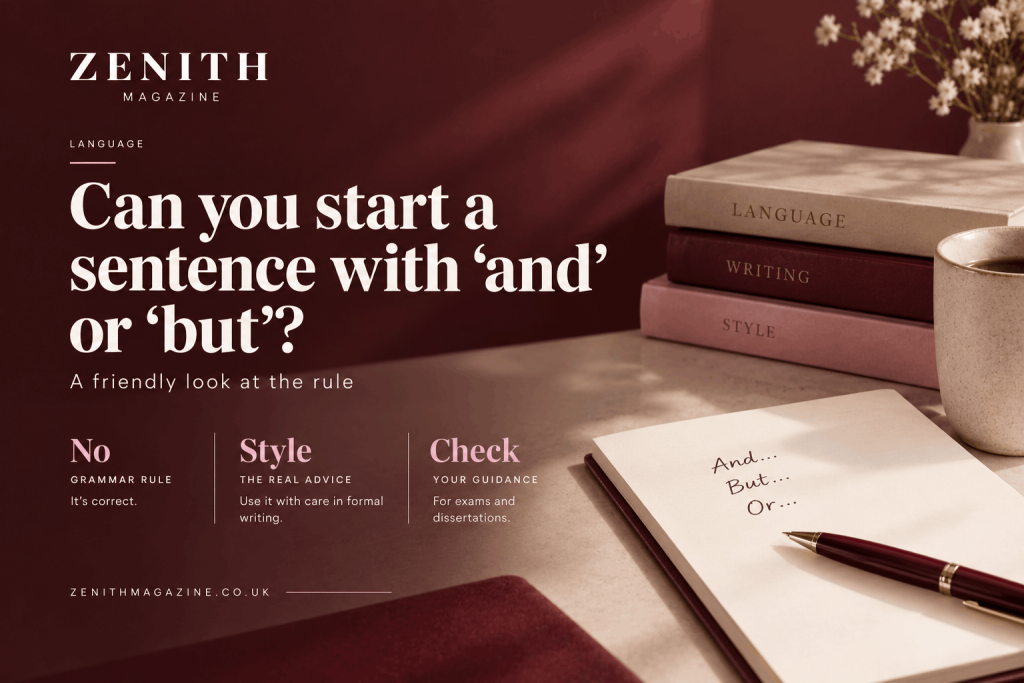
Can you start a sentence with and? Yes. It is grammatical, and usage guides including Fowler’s call the ban a superstition. The real advice is about style: too many sentences opening with and or but sound choppy, and some tutors, examiners and formal settings prefer words such as however or in addition. For a dissertation or exam, check the guidance you have been given.
Key Takeaways
- No grammar rule forbids beginning a sentence with a coordinating conjunction such as and, but or or. The objection is stylistic and mostly comes from school teaching.
- Formal writing is where caution makes sense. One university guide lists But and And among the words to avoid at the start of a sentence, while saying it is not wrong.
- We could not read APA’s or MLA’s own pages on this, so check your department’s guidance rather than assuming either style forbids it.
Can you start a sentence with and or but? The short answer
Yes. And, but and or are coordinating conjunctions: small words that join words, phrases or clauses. Beginning a sentence with one is correct grammar, and it has been done for centuries.
The Cambridge Grammar of the English Language (Huddleston and Pullum) says such coordinators “can occur in sentence-initial position”, as quoted by the Grammarphobia blog. The question people actually need answered is not “is it legal?” but “will it suit this piece of writing?”
Is it grammatically correct to start a sentence with and?
Yes. Grammar and style are different things here. Nothing in the grammar of English stops a sentence beginning with and, but style advice, which varies by audience, may steer you towards other openers in formal work. The sections below separate the two.
Where the rule came from: why were we told not to start a sentence with and?
The tradition is older in classrooms than in grammar books, and the sources we found trace it to a few places.
- A single Victorian remark. According to Grammarphobia, Merriam-Webster’s Dictionary of English Usage traced the idea to George Washington Moon’s 1868 book, which says “It is not scholarly to begin a sentence with the conjunction and.” That was the only printed example of the prohibition the dictionary’s editors could find, and Moon objected on style, not grammar. Edwin Battistella, writing for the Oxford University Press blog, adds that the rule is not found in the prescriptive grammars of Robert Lowth or Lindley Murray.
- The classroom. Battistella and the editor Merrill Perlman, in the Columbia Journalism Review in 2011, both cite the linguist Arnold Zwicky’s suggestion that the blanket rule began in elementary schools, where children overused and and teachers banned it outright.
- A changing sense of tone. Battistella quotes research by Heidrun Dorgeloh suggesting that sentence-initial and came to be linked with older, more narrative writing, and was increasingly stigmatised as less professional.
- Long practice before the rule. The Oxford English Dictionary, as cited by Grammarphobia, records sentence-initial and from Old English, in the 9th century. Burchfield’s revision of Fowler’s Modern English Usage says the prohibition has been “cheerfully ignored by standard authors from Anglo-Saxon times onwards”. Battistella notes that it is common in the King James Bible.
All of these are second-hand accounts of the original sources, so they are only as reliable as the pages that report them.
What guides say
Coordinating conjunctions at the beginning of a sentence rule: what grammarians say
The major usage authorities, as reported by the sources above, agree there is no rule.
- Fowler: Ernest Gowers’s 1965 revision called the idea “a faintly lingering superstition” (reported by Battistella).
- Garner’s Modern American Usage calls it a “rank superstition” (reported by Battistella and Grammarphobia).
- The American Heritage Dictionary, fourth edition, says grammarians have ridiculed the rule for decades (reported by Perlman).
- The Chicago Manual of Style, 16th edition (2010), says the belief has no historical or grammatical basis, and that as many as 10 per cent of sentences in first-rate writing begin with a conjunction (reported by Wikipedia, which we could not check against Chicago itself).
Starting a sentence with and myth vs reality
| The claim | What the sources say |
| It is ungrammatical. | Grammarians describe it as a superstition. |
| It is a very old rule. | The earliest printed objection the Merriam-Webster editors found is from 1868. |
| Good writers avoid it. | Perlman reports that writers from Shakespeare to Joyce Carol Oates have ignored it, citing the American Heritage Dictionary. |
| Teachers always enforce it. | Perlman says whether teachers enforce it is itself largely a myth, though that is a US writer’s view. |
| It is fine everywhere. | Not quite. Some formal settings prefer other openers. |
APA style rule for beginning a sentence with and
We could not load APA’s own pages. A US university library answer says APA does not place “much restriction” on starting a sentence with And or But, though it adds that for scholarly writing it is typically avoided to start with And. That is a library’s reading, not an APA statement, so check the APA Publication Manual or your department.
Starting sentences with conjunctions in MLA format
We found no MLA statement on the subject. MLA is best known as a citation format, so a department’s own guidance is the safer thing to check before relying on it.
What university and writing-centre guides say
Trinity College Dublin’s academic writing page has a section titled “Avoid starting sentences with words such as:”, and But and And are on the list. It also says “It is not ‘wrong’ to begin a sentence with these words”, and adds that it is “often difficult to control the grammar of the rest of the sentence” when you do.
The Texas A&M Writing Center takes a more relaxed line. It says you can start a sentence with either word, that but adds a more personal tone, and that the thing to watch is overuse.
When to avoid starting with and or but
Can you use and to start a sentence in a dissertation?
Grammatically, yes. In practice, many supervisors and departments prefer a more formal tone, and one university guide we found lists And and But as words to avoid. We found no rule that applies to every dissertation.
The safe approach is to check your department’s guidance, ask your supervisor, and where in doubt choose a transition such as in addition or however. That costs nothing and avoids an argument you do not need to have.
Can you start a sentence with an and in formal writing?
Formal writing is where the stylistic objection carries most weight, because readers there expect a traditional tone. One editor commenting on Battistella’s post argued that a sentence starting with a conjunction can seem to be missing a thought. That is one editor’s view, not a rule.
Is there a penalty for starting sentences with and in school essays?
We found no published rule that penalises it, but we did not review exam board mark schemes, so we cannot say whether any marking guidance mentions it. An individual teacher may still discourage it, often because pupils overuse and. If you are working to a mark scheme, ask your teacher what they expect.
Formal essay vocabulary transitions instead of and
If you want to avoid opening with and or but in a formal essay, the Texas A&M Writing Center suggests phrases such as “in addition”, “also”, “however” and “on the other hand”.
| Instead of opening with | Try | Use it for |
| And | In addition, | Adding a further point |
| And | Also, | Adding a point lightly |
| But | However, | Contrasting with the previous sentence |
| But | On the other hand, | Setting up an alternative |
These swaps change the tone as well as the word, so read the sentence again afterwards.
Examples: when it works and when it does not
These sentences are our own illustrations.
- Works: “The forecast said sun. But the rain arrived by noon.” The short sentence gives the contrast room to land.
- Works: “He tried again. And again.” The repetition is the point.
- Weak: “We arrived at the hotel. And we put our bags in the room. And we went for dinner. And we walked home.” Battistella’s sample of plain sequential narration makes the same point: the problem is overuse.
- Formal rewrite: “The sample was small. However, the results were consistent.” This keeps the contrast without the casual tone.
Tips for using and and but at the start of a sentence
- Ask whether the sentence needs the opener at all. If it does not, delete it.
- Use it sparingly. One or two in a page is a matter of rhythm, and a dozen is a habit.
- Keep the sentence short. Trinity College Dublin warns that the grammar of the rest of a sentence can become hard to control.
- In formal work, check the institution’s guidance and use a transition if in doubt.
- Do not treat a grammar checker as the authority. Perlman noted in 2011 that some versions of Microsoft Word flagged sentence-initial conjunctions, so a flag does not mean an error.
Frequently Asked Questions
Is it wrong to begin a sentence with ‘and’?
No. It is grammatical, and usage authorities including Fowler and Garner describe the ban as a superstition. Overuse can sound choppy, and formal settings sometimes prefer other openers, but that is a matter of style rather than correctness.
Can you start a sentence with but?
Yes, on the same basis. Fowler, as reported by Wikipedia, says the belief that but cannot start a sentence has no foundation. The Texas A&M Writing Center says it can add a more direct, personal tone. Use it with care in formal work.
Why do teachers say not to start a sentence with and?
The sources we found suggest it began as classroom advice to stop children overusing and, then hardened into a blanket rule. The earliest printed objection that Merriam-Webster’s editors found dates from 1868, and it was about style rather than grammar.
Can I start a sentence with and in a dissertation?
It is not ungrammatical, but formal academic work often prefers a more traditional tone. One university guide lists And and But among words to avoid at the start of sentences. Check your department’s guidance, or choose a transition such as in addition.
What can I use instead of and or but at the start of a sentence?
For and, try in addition or also. For but, try however or on the other hand. The Texas A&M Writing Center suggests all four. These are more formal, so check that the tone suits the rest of your piece.
Will I lose marks for starting a sentence with and in an essay?
We found no published rule that says so, and we did not review exam board mark schemes. Individual teachers may discourage it. If marks matter, ask your teacher or check the guidance for your qualification.