
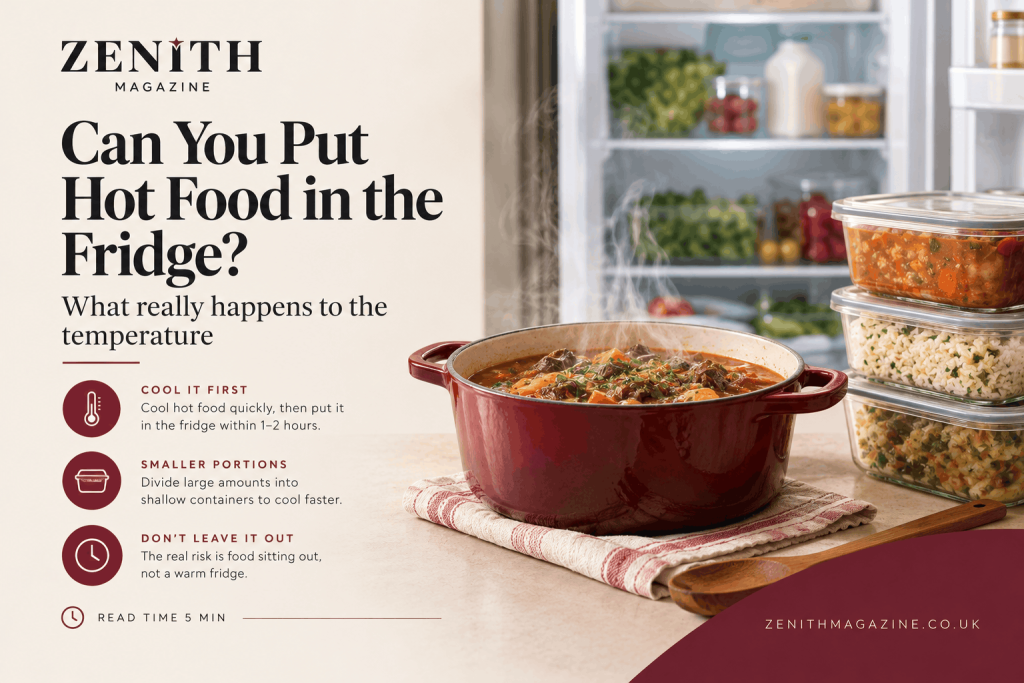
Quick Answer
Cool it first, but only briefly. The Food Standards Agency (FSA) says not to put hot or warm food in the fridge, and to cool cooked food quickly and get it into the fridge within one to two hours. Divide big batches into shallow containers to speed things up. Rice should be chilled within one hour.
Key Takeaways
- The real danger is not a warm fridge, it is food sitting out. Leaving a pot on the hob overnight is far riskier than a short spell of extra work for your fridge.
- UK and US advice differ. UK sources say cool food first, while US guidance says small amounts can go straight into the fridge. We follow the UK sources.
- Speed matters more than waiting for food to go fully cold. Smaller, shallower portions cool much faster than one big pot.
Can you put hot food in the refrigerator? The old rule and where it came from
Can you put hot food in the fridge? Many of us were told no, wait until it has gone cold. The rule has a real basis, though it gets stretched too far.
The worry is the appliance and the food around it. Bosch’s UK advice says the concern is less about the hot food you are trying to cool and more about everything else in the fridge: warm items create condensation, and the temperature clash affects the rest of the contents. Beko’s UK support pages say putting hot food in the fridge will raise the internal temperature significantly and suggest letting food cool completely first. A Samsung support page says a hot dish can go in, but it can cause condensation and a temporary spike in energy use, so it suggests waiting about 30 minutes.
The stretch is “completely cold”. Leaving food out until it reaches room temperature, or overnight, gives bacteria time to multiply. A retailer’s advice page from Currys is blunt that it is not safe to leave hot food out overnight to cool.
You will also find forum threads, including ones titled “can you put hot food in the fridge reddit”, that repeat the old rule and its opposite with equal confidence. Neither is quite right, as the rest of this article explains.
Should you put hot food in the refrigerator? What current advice says
Should you put hot food in the refrigerator? The FSA’s household advice says not to place hot or warm food in the fridge, and its guidance on chilled food says to cool cooked food quickly at room temperature and put it in the fridge within one to two hours. So the UK answer is: cool it quickly, then chill it, and do not leave it out for long.
Other bodies put it differently. The US Department of Agriculture (USDA), as reported by The Takeout and Healthline, says small amounts of hot leftovers can go straight into the fridge, and recommends dividing large amounts into smaller containers. Healthline adds that it is unclear whether refrigerating large dishes while hot is harmful and suggests letting soups, casseroles and stews cool first, then refrigerating them within two hours. Both US and UK sources agree on the two-hour limit.
Putting hot leftovers in refrigerator conditions: what to do instead
Putting hot leftovers in refrigerator space straight from the pan is best avoided on UK advice. Divide them, let them cool briefly, then chill them within one to two hours.
What happens if you put hot food in the fridge?
A hot item raises the temperature inside the fridge for a while, according to Bosch, Samsung and a ScienceABC explainer, and the compressor works harder until things settle. Condensation can form on or near the food.
Fridge temperature drop hot food: how much does it matter?
We found no UK test data on how far a typical fridge warms when a pot of hot food goes in, and we did not run a thermometer test for this article. Appliance makers say the effect is temporary. The practical point is that your fridge should be at 5°C or below, and the FSA says to check it with a thermometer, as dials do not always show the right temperature.
Putting hot food in fridge bacteria growth
Why does speed matter? Bacteria multiply fastest between roughly 5°C and 63°C. That range is called the danger zone by safefood, the food safety body for the island of Ireland. We did not retrieve the FSA’s own figures for the range. Chilling slows bacterial growth, so every hour food spends in that range counts. That is why the advice is a time limit of one to two hours, not a rule about the food being cold.
safefood also notes that putting hot food in the fridge can raise the temperature of the fridge, which is the trade-off to manage. Divide, cool quickly, then chill.
Putting warm food in fridge myth: what is true and what is not
- Myth: hot food must be completely cold first. False. Cooling hot food before refrigerating it means cooling it quickly, not waiting until it is cold. Waiting that long lets food linger in the danger zone.
- Myth: hot food in the fridge will ruin it. Overstated. A temporary temperature rise and condensation are real, but they are manageable with smaller portions.
- True: leave food out as little as possible. Cool it quickly and get it chilled within one to two hours.
How long to let food cool before putting in the fridge
How long to let food cool before putting in the fridge? As short a time as you can. The FSA’s limit is one to two hours. Samsung suggests about 30 minutes for a hot dish, and Bosch says to refrigerate within two hours. safefood advises throwing away high-risk food that has been out of the fridge for more than two hours.
For rice, the clock is shorter, as the next section explains.
Food cooling danger zone: how to cool leftovers quickly
How to cool leftovers quickly is the practical part. Food safety cooling methods that UK and other sources recommend:
- Divide it up. Love Your Leftovers, the UK food waste campaign, says to divide a large amount into smaller, shallow containers so it cools faster. Bosch makes the same point.
- Use shallow containers. Shallow dishes let heat escape faster than one deep pot.
- Try stainless steel. Bosch says stainless steel transfers heat from food much faster than plastic, so you can cool food in steel and then move it to plastic for storage.
- Use an ice bath for soups. Michigan State University Extension in the US suggests standing a container in a sink of ice and water and stirring. We found no UK source for this method.
- Keep an eye on the clock. Aim for the fridge within one to two hours.
Cooling rice, soup and stew
Rice is the special case. Food Standards Scotland (FSS) explains that uncooked rice can contain Bacillus cereus spores, which can survive cooking, and that the longer cooked rice sits at room temperature the more likely it is that toxins will make it unsafe. It advises chilling rice as quickly as possible, ideally within one hour, taking it out of the rice cooker or pan to cool it faster, dividing it into smaller portions, and putting it into the fridge once it is at room temperature. FSS says to eat it within 24 hours.
Soup and stew hold heat for a long time in a deep pot. Pour them into several shallow containers, or use the ice bath above, rather than leaving the pot to cool on the hob.
Can you put hot soup in the fridge?
Not straight from the pan, on UK advice. Cool it quickly in smaller, shallow containers first, then refrigerate it within one to two hours. The USDA’s advice allows small amounts of hot food in directly, but says large pots should be divided or cooled first.
Can you put hot containers in the fridge?
It depends on the container, as well as the food. Retailer guidance says hot glass can crack from thermal shock unless it is a thermal-shock-resistant type such as borosilicate (W&P, a US kitchenware brand), and Made In, a cookware brand, says never to put a hot pot, pan or plate directly into the fridge or freezer if it is not thermal-shock-resistant. The safest approach is to move the food into a storage container rather than putting the cooking vessel in.
Hot pan in fridge damage
A pan that has just come off the heat can stress its coating, warp, or crack a glass lid or a glass fridge shelf, according to cookware retailers. These warnings come from manufacturers and retailers, not from UK safety bodies, so treat them as practical cautions.
Fridge crowding
A packed fridge cools badly, and a hot dish makes it worse. Safe food storage guidelines from the FSA and safefood agree on the basics. The FSA’s advice is not to overfill the fridge so air can circulate. When the fridge is full, such as at Christmas, FSA guidance reported in the press suggests taking out items that do not need chilling, such as unopened soft drinks or bread, to make room. safefood also says not to overpack the fridge and to keep cooked foods and leftovers on the middle and top shelves, with raw meat on the bottom shelf.
For freezing, GOV.UK guidance for food businesses says to cool cooked dishes before putting them in the freezer. For more on freezing and leftovers, see our guides to how long cooked chicken lasts in the fridge, freezing milk and refreezing chicken.
Frequently Asked Questions
Should hot leftovers cool on the worktop first, or go straight into the fridge?
On UK advice, cool them quickly first, then chill them. The FSA says not to put hot or warm food in the fridge and to get cooked food in within one to two hours. Divide large amounts into shallow containers to speed it up.
How long to let food cool before putting in the fridge?
As briefly as possible: the FSA says one to two hours at most. Rice should be chilled within one hour, according to FSS. Samsung suggests about 30 minutes for a hot dish. Food left out for more than two hours should be thrown away.
Can you put hot soup in the fridge?
Not straight from a hot pan, on UK advice. Divide it into smaller, shallow containers, cool it quickly, and refrigerate within one to two hours. A pot left to cool on the hob for hours, or overnight, is the bigger risk.
What happens if you put hot food in the fridge?
The fridge’s temperature rises temporarily, the compressor works harder, and condensation can form, according to appliance makers. Smaller portions limit the effect. The bigger food safety risk comes from leaving food out for too long.
Can you put hot containers in the fridge?
Not if they are glass or ceramic that cannot take thermal shock, and not hot pans. Retailers warn that cooking vessels can crack or warp. Move the food into a storage container instead, and let the container cool a little first.
How to cool down hot food quickly for the fridge?
Divide it into shallow containers, use stainless steel, and stir. For soups, an ice bath helps. Take rice out of the pan and spread it into small portions. Aim to get everything into the fridge within one to two hours, or one hour for rice.