Quick Answer
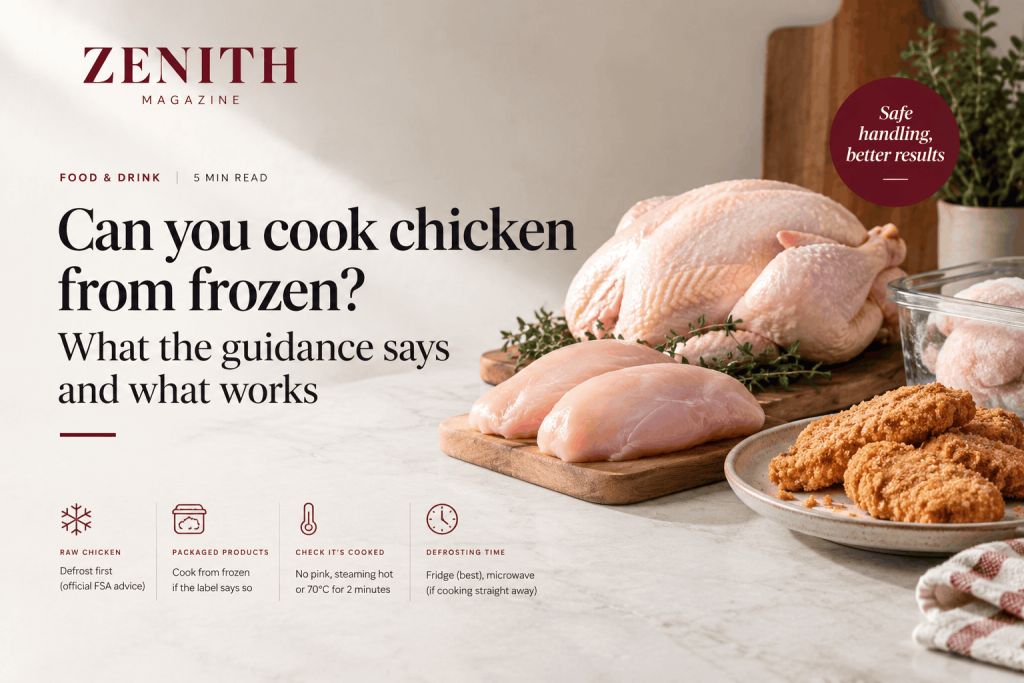
Defrost raw chicken fully before cooking. The Food Standards Agency (FSA) advises against cooking it from frozen because it can cook unevenly, which raises the risk of food poisoning. The exception is products whose packs say to cook from frozen, such as many breaded nuggets and goujons. Follow the label and check the centre is steaming hot.
Key Takeaways
- “Frozen chicken” is not one thing. A raw whole bird, a bag of home-frozen breasts and a box of breaded goujons each come with different advice.
- Breaded products can look cooked but often contain raw chicken. Treat them as raw and stick to the pack instructions.
- Cooking is only half the job. Checking the thickest part, or using a probe, is how you know it is safe.
The short answer: can you cook chicken from frozen?
Can you cook chicken from frozen? For plain raw chicken, the official position in the UK is no, not if you can help it. Which?, reporting FSA advice, says the agency strongly advises against cooking raw chicken from frozen because it can lead to uneven cooking and bacteria growth. The worry is simple: the outside can look done while the centre is still too cold to have been cooked properly.
There is a clear exception. Packaged products that are made to be cooked from frozen, and say so on the label, are fine to cook that way. Which? makes the same distinction: prepackaged food can go straight in the oven if the packaging says so, while items you have frozen yourself should be thoroughly defrosted first, because home-frozen portions vary in size and cooking times are harder to judge.
So the rule of thumb is: the label decides for packaged food, and defrosting is the default for everything else.
Whole chicken versus breasts and thighs
Whole chickens
A whole bird is the hardest case. It is thick and dense, so the middle takes longest to come up to temperature. Retailer labels reflect this: one supermarket whole chicken listing states that the bird cannot be cooked from frozen and should be defrosted thoroughly in the fridge for a minimum of 12 hours. For larger birds, FSA Christmas advice says to check the label (some smaller frozen birds can be cooked from frozen) and to allow extra time, as a whole turkey can take 3 to 5 days to defrost properly. That advice applies to England and Wales.
As a guide, Which? says meat and poultry generally take 10 to 12 hours per kilo to defrost in the fridge.
Breasts, thighs and drumsticks
The FSA’s position on raw chicken does not carve out a special rule for portions, so the safe default is the same: defrost first, then cook. Smaller pieces thaw faster than a whole bird, which makes the defrosting step less of a chore. That point is our reading rather than a published FSA rule.
You will find plenty of recipes online that cook raw breasts straight from the freezer. They sit outside the FSA advice above, and the cooking times they quote vary. We are not giving cook times here, because we have not tested them and none are published by the FSA for this situation.
Breaded and ready-to-cook chicken products
This is where the answer flips. Nuggets, goujons, dippers, poppers and kievs are usually designed to go into the oven or air fryer from frozen, and the pack will say so.
Two cautions come straight from the FSA and Food Standards Scotland (FSS):
- They often contain raw chicken. The FSA warns that frozen chicken products may look pre-cooked on the outside but often contain raw chicken, so they should be treated as raw. Some products are sold fully cooked and frozen, so read whether the label says raw or cooked.
- Follow the pack exactly. Different brands of the same type of product can have different instructions. Preheat the oven so it is up to temperature, use the stated temperature and time, and do not turn the oven down because you are cooking chips alongside.
The advice follows a Salmonella outbreak. FSS reported 511 UK cases of salmonellosis between January 2020 and May 2021, caused by two strains of Salmonella Enteritidis and linked to frozen, raw, breaded chicken products. A survey commissioned by the FSA and FSS and carried out by Ipsos MORI found that 46% of adults who cook coated frozen chicken do not always check the cooking instructions. Which?, reporting the same research, says 27% of people cooking these products with chips or vegetables would use a lower temperature than the pack states.
Where a pack says to defrost before cooking, do as it says, and defrost in the fridge, not at room temperature.
Checking the chicken is properly cooked
Whichever route you take, cooking chicken through is what makes it safe. Campylobacter, the main cause of bacterial food poisoning in the UK, is linked to undercooked poultry, so the check matters.
The visual check
The FSA’s advice is to cut into the thickest part and check that:
- the meat is steaming hot all the way through
- there is no pink meat
- the juices run clear
For a whole chicken, the thickest part is the leg between the drumstick and the breast.
The thermometer check
A clean probe thermometer pushed into the centre takes the guesswork out. GOV.UK’s guidance on cooking food safely gives the standard advice as a core temperature of 70°C for 2 minutes, and lists other equivalent combinations:
| Core temperature | Time held |
| 60°C | 45 minutes |
| 65°C | 10 minutes |
| 70°C | 2 minutes (standard advice) |
| 75°C | 30 seconds |
| 80°C | 6 seconds |
That table comes from guidance written for food businesses. At home the FSA’s own household advice leans on visual cues and says a food thermometer can be used as well.
When it is better to defrost chicken first
Defrost first when:
- it is a whole bird or bone-in joint
- you froze it yourself, so there is no pack guidance
- the label says it is not suitable for cooking from frozen
- you are cooking it in a sauce or a dish where you cannot easily check the middle
How to defrost chicken safely
- In the fridge (best). Put the chicken in a covered container on the bottom shelf, away from cooked food, so juices cannot drip. FSS advises checking the chicken is fully defrosted before you cook it.
- In the microwave, if cooking straight away. Which?, reporting FSA advice, says to use the microwave’s defrost setting if you are about to cook, and to cook immediately afterwards.
- Never at room temperature.
Do not wash raw chicken. The FSA says it can splash bacteria onto hands, worktops and nearby food.
If a barbecue or a busy midweek night catches you out, the microwave route is the fastest approved option. Otherwise, a quick check of the freezer in the morning saves the problem.
Frequently Asked Questions
Can you cook chicken breast from frozen?
The FSA’s advice is to defrost raw chicken, including breasts, before cooking, because the centre may not cook evenly. The exception is a packaged product whose label says it can be cooked from frozen. If you froze the breasts yourself, defrost them first.
Can you cook frozen chicken nuggets and goujons from frozen?
Yes, if the pack says so, and most do. These products often contain raw chicken under the coating, so follow the temperature and time on the pack, preheat the oven and check they are steaming hot in the middle before serving.
Can you cook other frozen food straight from the freezer, such as prawns, steak or burgers?
It depends on the product. Which?, reporting FSA advice, says mince and sausages should be defrosted first. For burgers, steak and prawns, follow the pack. FSA guidance says burgers should not be served pink at home. We cover prawns in our guide to cooking prawns from frozen.
How can you tell chicken is cooked through?
Cut into the thickest part and check that it is steaming hot, with no pink meat and clear juices. A clean probe thermometer in the centre is more reliable. GOV.UK gives the standard core temperature as 70°C held for 2 minutes.
Is it safe to defrost chicken in the microwave?
Yes, using the defrost setting, as long as you cook the chicken straight afterwards, because parts may begin to cook while others stay frozen. Which?, reporting FSA advice, says not to defrost chicken at room temperature. The fridge is the safest choice if you have time.
What if you forgot to defrost the chicken?
Use the microwave defrost setting and cook immediately, or switch to a packaged product that is labelled for cooking from frozen. Check the chicken is fully defrosted before it goes in the pan or oven.