
Quick Answer
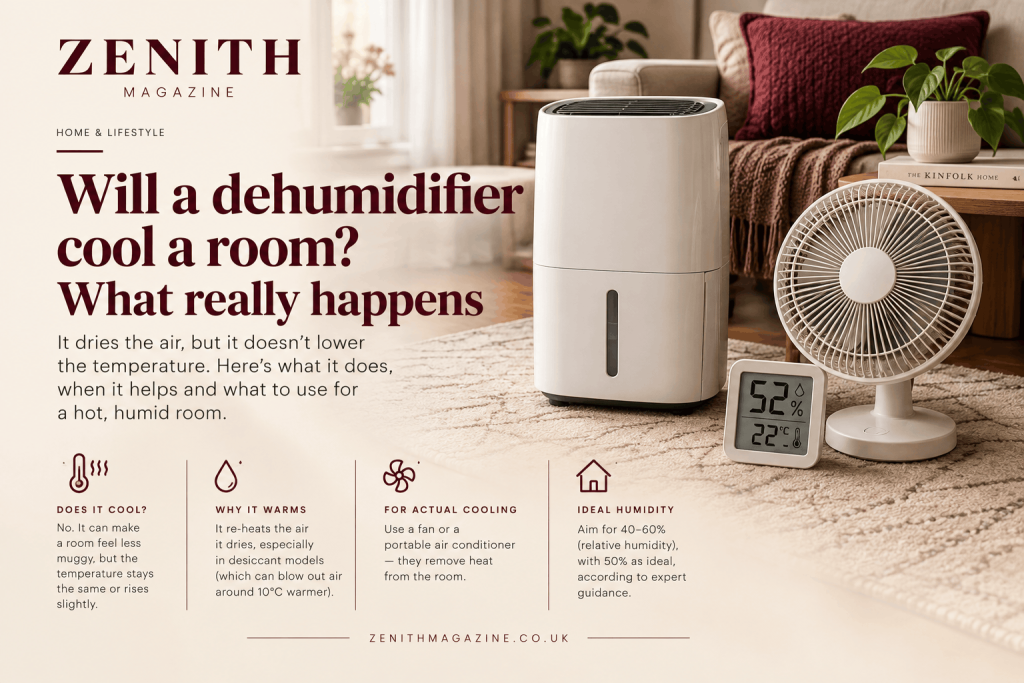
No. A dehumidifier dries the air but reheats it, so the room usually stays the same temperature or gets slightly warmer. Desiccant models blow out air about 10°C warmer than the room. It can make a humid room feel less sticky, but for a hot room a fan or an air conditioner does the cooling.
Key Takeaways
- A compressor dehumidifier blows out air at roughly room temperature, and a desiccant model blows out air about 10°C warmer, so neither is a cooling appliance.
- Dry air can feel more comfortable because sweat evaporates more easily, which is a change in how the room feels, not in the thermometer reading.
- A 220W dehumidifier costs roughly 6p an hour to run at the October to December 2026 price cap (our calculation), against up to £5 a day for a portable air conditioner (Energy Saving Trust).
The short answer
Will a dehumidifier cool a room? Manufacturers and reviewers agree it will not. Chris Michael, managing director of Meaco, told Homebuilding that the answer to whether a dehumidifier can cool a room is “definitely no”.
The reason is simple. A dehumidifier pulls water out of the air, and the machine itself runs on electricity that ends up as heat in the room. The question readers often ask is whether a dehumidifier cools a room by taking the damp out of it. In practice, does a dehumidifier cool a room? It does not, and the thermometer rarely moves down.
Does removing humidity make a room cooler?
Not in a way you can measure on a thermometer. Does removing humidity make a room cooler? The air feels different, because dry air lets sweat evaporate, but the air temperature stays about the same or edges up. We found no manufacturer or UK body that claims a dehumidifier lowers air temperature.
Do dehumidifiers lower the temperature?
Do dehumidifiers lower the temperature? Not as a rule. Can dehumidifier cool room air in any useful way? Only by making it feel less muggy, which is covered further down.
Do dehumidifiers blow cold air?
Do dehumidifiers blow cold air? No. TechRadar says compressor dehumidifiers blow out air at roughly room temperature, and desiccant models blow out air about 10°C (18°F) warmer than the room. The cold part of the machine is inside, where moisture condenses.
Why it can warm a room
Why does a dehumidifier blow warm air?
Why does a dehumidifier blow warm air? Homebuilding explains that a compressor model has two coils. The first is cold and makes water condense out of the air. The second warms the dried air back up to just above room temperature before it leaves the machine.
Desiccant models work differently. Homebuilding says they use a material called Zeolite (a mineral that soaks up moisture) and an internal heater to release the water, so they can act as a gentle heater. TechRadar puts their exhaust about 10°C warmer than the room, but adds that this is not enough to count as a room heater.
Why does my dehumidifier make the room feel hot?
Why does my dehumidifier make the room feel hot? There are two likely causes, and the second one is our interpretation rather than something a source states.
- The reheated air coming out is slightly warmer than the room, and a desiccant model is warmer still.
- The machine works best with windows and doors shut, which Expert Reviews recommends, so a closed room has nowhere to lose that extra warmth.
If the room is also hot from the sun, a dehumidifier will not help with that.
Dehumidifier heat output btu
Dehumidifier heat output btu is a figure we could not find from any manufacturer. Here is a calculation instead, which is ours and not a published specification. A BTU (British thermal unit) is a measure of heat, and one watt is about 3.412 BTU an hour. Expert Reviews gives the example of a MeacoDry Arete Two using around 220W. That is about 750 BTU an hour if all the electricity is counted as heat, which is basic physics rather than a manufacturer claim. On that basis it is a small heat source, not a heater.
When it helps comfort
Does high humidity make it feel hotter?
Yes. Does high humidity make it feel hotter? The Met Office explains that evaporating sweat cools the body, and that “when humidity is high, the rate of evaporation and cooling is reduced, resulting in it feeling hotter than it actually is”. The Met Office blog was published on 15 February 2012 and updated on 17 March 2022.
That is the one real benefit. If a warm room is also damp, taking moisture out can make it feel more comfortable even though the thermometer stays put. It is a comfort gain, not a cooling one.
How to use a dehumidifier to cool a room
How to use a dehumidifier to cool a room is a slightly misleading question, because the machine does not cool. What you can do is get the most out of it in a warm, muggy room. Expert Reviews suggests:
- Place it centrally in the room.
- Clean the filter.
- Use it in a smaller room with the doors closed.
- Keep the windows closed.
- Use a humidity-stop mode, if the model has one, so it switches off at the level you set.
Pair it with a fan, covered below, for the cooling effect.
Ideal indoor humidity level for summer
For the ideal indoor humidity level for summer, we found no figure that is specific to summer. Ideal Home quotes Meaco’s Chris Michael saying 40 to 60% relative humidity is fine and 50% is perfect, with mould a risk above that. Dryzone’s Dr Jonathan Kirby also gives 40 to 60%, citing the Institute of Air Quality Management. AO.com suggests 30 to 50% for dehumidifier settings and says over 50% can encourage mould and dust mites. A cheap hygrometer (a humidity meter) will show where your room sits.
Signs you need a dehumidifier in your bedroom
For signs you need a dehumidifier in your bedroom, the sources we read point to the reading on a hygrometer rather than a checklist. Consistently above 50%, per AO.com, is where mould and dust mites can become a problem. South Kesteven District Council’s damp advice also lists condensation on windows as something to wipe up and to cut at source. We did not find a source that lists other bedroom symptoms, so we have not invented any.
How to lower humidity in a room without a dehumidifier
How to lower humidity in a room without a dehumidifier comes down to making less moisture and letting it out. South Kesteven District Council advises:
- Cover pans and use extractor fans or open windows when cooking.
- Dry washing outside if you can, or use a ventilated room with the door closed, and not on radiators.
- Vent tumble dryers outside.
- Keep trickle vents open and never block airbricks.
- Leave space between furniture and walls so air can circulate.
On hot days, remember the Energy Saving Trust’s warning that opening windows only helps when the outside air is cooler than inside.
Fans and portable air conditioners
If the real aim is a cooler room, the Energy Saving Trust is clear about the order of play. Stop heat getting in first: close windows and curtains during the day, and open them at night or early morning only when it is cooler outside.
Fans
The Energy Saving Trust says fans “don’t lower the room temperature” but help your body cool by making sweat evaporate. They are the cheapest option to run, at £0.14 to £0.30 per 24 hours in Great Britain. The Trust, citing the NHS, says electric fans work best when temperatures are below 35°C.
Portable air conditioners
The Energy Saving Trust says portable air conditioners cool rooms quickly but cost more to buy and use far more energy. It says running one “costs up to 20 times more than a fan” and puts it at £4.62 to £5 per 24 hours in Great Britain. T3 gives the typical range as 700 to 1,500 watts. Homebuilding adds that portable units need a window duct and a container for condensation.
Dehumidifier vs air conditioner for cooling
For dehumidifier vs air conditioner for cooling, there is only one winner on temperature: the air conditioner. Homebuilding quotes David Hilton saying air conditioners dehumidify as a side effect. That is why portable air conditioner vs dehumidifier is not a close comparison: one removes heat and moisture, the other only moisture.
Can a dehumidifier replace an AC? No. It dries the air, and an air conditioner is the appliance that lowers the temperature.
| Dehumidifier (compressor) | Fan | Portable air conditioner | |
| Lowers air temperature | No | No | Yes |
| What it does | Removes moisture | Helps sweat evaporate | Cools and dries the air |
| Typical power | Around 220W (one example) | 25W to 80W (T3) | 700W to 1,500W (T3) |
| Cost per 24 hours | About £1.39 (our calculation) | £0.14 to £0.30 (EST) | £4.62 to £5 (EST) |
Swamp cooler vs dehumidifier
A swamp cooler is an evaporative cooler, which cools air by passing it over water. For swamp cooler vs dehumidifier, they do opposite things: the cooler adds moisture and the dehumidifier removes it. Hunker says evaporative coolers add humidity, up to 70% for powerful units, and that on the whole they are not suitable for muggy, humid climates. The Energy Saving Trust also warns they can increase the moisture in the air in your home. The Trust puts their running cost at £0.27 to £0.39 per 24 hours in Great Britain.
Choosing a dehumidifier for damp
If your problem is damp, not heat, a dehumidifier is the right tool. Homebuilding says compressor models suit damp prevention and drying clothes, and desiccant models suit cold spaces.
Using a dehumidifier in winter vs summer
For using a dehumidifier in winter vs summer, the main difference is temperature. TechRadar says compressor efficiency drops below about 15°C, and the colder the air, the less water they collect. Desiccant models cope below 10°C and suit garages, conservatories and unheated rooms. In summer, a compressor model works at its best.
Best dehumidifier for a hot humid room
For the best dehumidifier for a hot humid room, the sources point to a compressor model. It works well in warm air, and the exhaust is closer to room temperature than a desiccant model’s. We have not tested any models, so we do not name one. Choose by room size and the water capacity on the label.
Does a dehumidifier use a lot of electricity?
Does a dehumidifier use a lot of electricity? Not much compared with an air conditioner. Expert Reviews’ example of around 220W works out at about 5.8p an hour at the Ofgem price cap of 26.32p per kWh that applies from 1 October to 31 December 2026 (our arithmetic). Run flat out for 24 hours, that is roughly £1.39 a day. Rates change, so check your own tariff.
Frequently Asked Questions
Does a dehumidifier cool a room?
No. A dehumidifier removes moisture, but the air it blows out is at about room temperature, or warmer with a desiccant model. It can make a muggy room feel more comfortable, but it will not bring the temperature down the way a fan or air conditioner can.
Why does a dehumidifier blow warm air?
A compressor model has a second coil that reheats the dried air to just above room temperature, according to Homebuilding. A desiccant model uses an internal heater, so its exhaust is about 10°C warmer than the room, per TechRadar.
Does a dehumidifier use a lot of electricity?
Not usually. An example model uses around 220W, which our calculation puts at about 5.8p an hour at the current price cap. A portable air conditioner costs £4.62 to £5 per 24 hours, according to the Energy Saving Trust, so it uses far more.
Can a dehumidifier replace an AC?
No. A dehumidifier dries the air but does not lower its temperature. A portable air conditioner cools and dries the room, which is why the Energy Saving Trust warns it costs up to 20 times more than a fan to run.
Does high humidity make it feel hotter?
Yes. The Met Office says that when humidity is high, sweat evaporates and cools you more slowly, so it feels hotter than the thermometer shows. Lowering humidity can improve comfort, but it does not change the actual air temperature.
What humidity should a home be?
Ideal Home quotes Meaco and Dryzone giving 40 to 60% relative humidity, with 50% seen as ideal. AO.com suggests 30 to 50% for dehumidifier settings. We found no separate summer figure. A hygrometer will show your room’s reading.