
Quick Answer
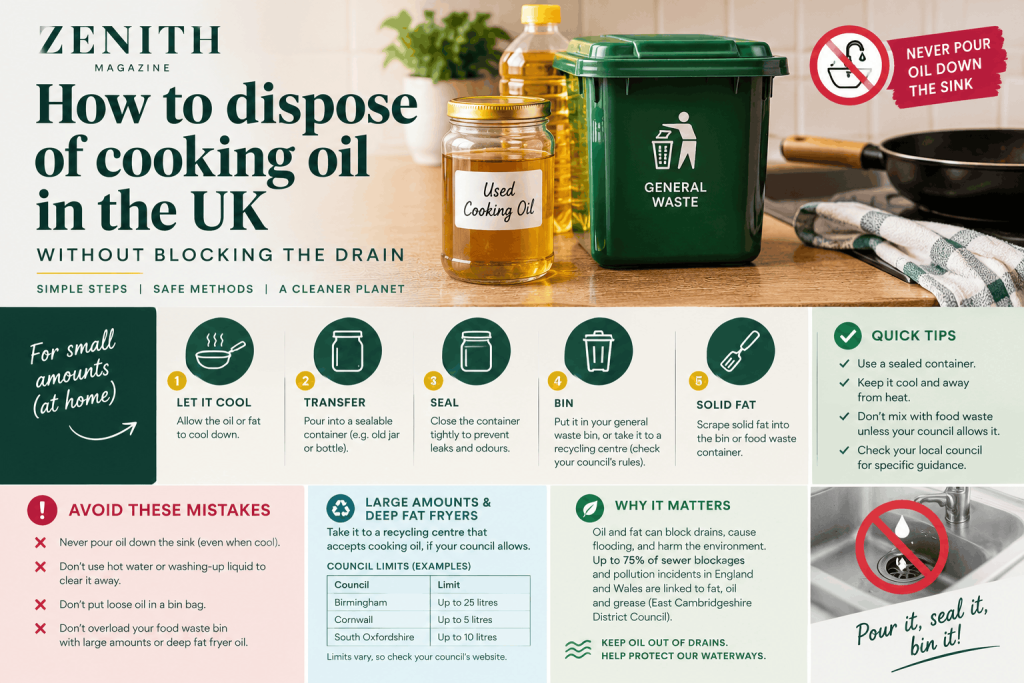
Let the oil cool, pour it into a sealable container such as an old jar or bottle, close it and put it in your general waste bin, or take it to a recycling centre that accepts it. Never pour it down the sink, even when cool. Solid fat can be scraped into the bin. Rules on food waste bins and quantities vary by council, so check yours.
Key Takeaways
- Cooled oil is not safe to pour away. Thames Water says oils float on water and cling to pipe walls, and that hot water and washing-up liquid do not clear them.
- Your council decides the details. Some take household oil free at recycling centres, with limits that range from 5 litres to 25 litres in the pages we read, while others point you to the bin.
- Large amounts and deep fat fryers need a different route from a frying pan. Do not assume a food waste caddy will take them.
Why it must not go down the sink
Cooking fat looks harmless while it is liquid and warm. It does not stay that way. Thames Water says fats, oils and grease should never go down sinks and drains, because oil floats on water and clings to the walls of the pipe, building up over time.
Pouring it away cool does not fix this, and neither does chasing it with hot water. Thames Water says water cools as it travels, so the grease hardens, and washing-up liquid does not break fats down.
The damage is not just a sluggish plughole. East Cambridgeshire District Council cites a figure that up to 75% of about 200,000 sewer blockages and pollution incidents a year in England and Wales are caused by fat, oil and grease. Fat can also lodge in the U-bend. Thames Water adds that a blocked pipe at home is the homeowner’s responsibility to fix and can cost more than £200. Scottish Water says fat, oil and grease can create fatbergs, block drains, cause flooding and harm nature.
Small amounts: how to dispose of cooking oil at home
This is the everyday case: the oil left in a frying pan or the fat from a roasting tin. People also search for “how to dispose of oil cooking”, and the answer is the same.
How to discard cooking oil at home
- Let the oil or fat cool.
- For fat that sets solid, Thames Water says to scrape it into the bin or a food waste container.
- For liquid oil, pour it into a sealable container, such as an old jar or bottle, seal it and put it in the bin.
- Use a sink strainer to catch food scraps.
Zero Waste Scotland says small amounts of oil, fat and fatty plate scrapings can go in the food waste bin. North London Waste Authority says liquid oil cannot go in its food waste bin. Oxfordshire County Council’s advice (a 2014 article) also allowed small amounts in the food waste bin. These sources disagree, so ask your council before using the caddy.
How to use paper towels to absorb kitchen grease
For greasy pans and plates, wipe them with paper towels or kitchen roll before washing and put the used towels in the bin (Thames Water). Oxfordshire County Council also suggested soaking larger amounts of oil into newspaper before binning. The Takeout, a US site, notes paper towels work for small amounts but waste a lot of them.
Can you throw cooking oil in the trash?
In the UK, the usual answer is yes, if it is sealed. Bromley Council lists the general waste bin as an option, with the oil in a sealed container or soaked into kitchen roll. Cornwall Council says the same, in a suitable container. Do not put loose oil in a bin bag or pour it straight into the bin.
How to solidify cooking oil for disposal
You do not have to solidify oil, since a sealed container is the standard UK advice. If you want to, these are the options we found:
- Cooling. Fat that sets on cooling can simply be scraped out (Thames Water).
- Commercial cooking oil solidifier powder. Products such as FryAway are stirred into hot oil, and the mixture sets as it cools. The Takeout says the maker does not disclose the formula and speculates it is mainly stearic acid, and that setting takes under an hour. Follow the pack, and note this is a US product reviewed by a US site.
- Gelatin method for oil disposal. The Takeout says gelatin can purify oil but leaves oil behind, and it is unsuitable for vegan, vegetarian, Kosher or Halal diets.
- How to harden cooking oil with baking soda. None of the UK or council sources we opened recommends it, and we found no tested method, so we are not giving quantities.
- Freezing cooking oil before throwing away. We found no source covering this either, so we cannot say whether it works or what the timings are.
Large amounts and deep fat fryers
A deep fat fryer holds far more than a frying pan, and councils treat it differently. Zero Waste Scotland says the food caddy suggestion applies to cooled frying pan contents, not to the contents of a deep fat fryer.
How to dispose of large amounts of cooking oil
Take it to a recycling centre that accepts it, if your council allows. The limits we found:
| Council | What it says |
| Cornwall | Up to 5 litres at a Household Waste and Recycling Centre (one named site does not take it) |
| West Sussex | Up to 25 litres at eight named sites, brought in a plastic bottle |
| North Yorkshire | Accepted free at all household recycling centres except Wombleton, no limit stated |
| North London Waste Authority | Pour cooled oil into a plastic or glass bottle and take it to a listed recycling centre |
Check your own council’s page before a trip. If the oil is from a business, it is a different matter: Scottish Water advises catering businesses to have leftover oil collected by a licensed waste contractor.
Where to dump used cooking oil near me
The honest answer is that it depends on your postcode. Do not “dump” oil anywhere: not in a drain, a gully, a garden or a public bin. Instead, search your council’s website for “cooking oil” or enter your postcode on its recycling centre finder. Cornwall, for example, has a postcode lookup for its 14 sites. Zero Waste Scotland reports that seven Sainsbury’s stores in Scotland had oil banks, but the page says “currently” and is undated, so verify before going.
Council schemes
Council advice differs enough that checking is not optional. In the pages we read:
- North Yorkshire accepts household cooking oil free at its recycling centres, and charges for commercial oil.
- Bromley allows the general waste bin, in a sealed container or soaked into kitchen roll, or its recycling sites.
- West Sussex says not to dispose of cooking oil at home and asks for it to be taken to one of its eight listed sites.
- Cornwall allows the bin in a sealed container or a recycling centre, up to 5 litres.
Collected oil is generally turned into fuel. North London Waste Authority says its oil is reprocessed as biofuel.
Search for your council’s “cooking oil” page, check the quantity limit and ask whether the site needs a booking slot. We did not use a national checker, and we could not verify whether a single UK-wide recycling finder lists oil, so the link to your council is the safest route.
Reusing oil safely
Disposal is easier if you use the oil more than once, but there is no UK official source in our research for how many times. King Arthur Baking, a US site, says frying oil can usually be reused two to eight times depending on the oil and what you fried, and recommends:
- Cool the oil completely, then strain it through cheesecloth in a fine mesh strainer into a clean container.
- Label it with the date and what you fried.
- Store it in a cool, dark place with a lid.
It says to discard oil that looks dark or dirty, smokes before reaching frying temperature, foams, or smells rancid. Oil takes on the flavour of what you fry, so keep it for similar foods. Treat this as US baking-site advice rather than UK food safety guidance.
Frequently Asked Questions
What is the best way to dispose of cooking oil?
Let it cool, pour it into a sealable container, close it and put it in the general waste bin, or take it to a recycling centre that accepts household oil. Never pour it down the sink. Check your council because the rules differ.
Can you throw cooking oil in the trash?
Yes in most UK council advice we read, provided it is sealed in a container or soaked into kitchen roll first. Councils such as Bromley and Cornwall list this. Do not put loose liquid oil into a bin bag.
Can I pour cooled cooking oil down the sink?
No. Thames Water says oils float on water and cling to pipe walls, building up over time, and that cooling does not make it safe. Hot water and washing-up liquid do not clear it either.
How do I dispose of large amounts of cooking oil?
Take it to a recycling centre that accepts it. Limits vary: Cornwall says up to 5 litres and West Sussex up to 25 litres at named sites. Do not assume a food waste caddy takes deep fat fryer oil.
Where can I take used cooking oil near me?
Search your council’s website for “cooking oil” or use its recycling centre finder with your postcode. Many councils accept household oil, but some sites do not, and some need a booking, so check before you go.
Can I put cooking oil in the food waste bin?
It depends on your council. Zero Waste Scotland says small amounts can go in, while North London Waste Authority says liquid oil cannot. Deep fat fryer contents should not go in at all, according to Zero Waste Scotland