
Quick Answer
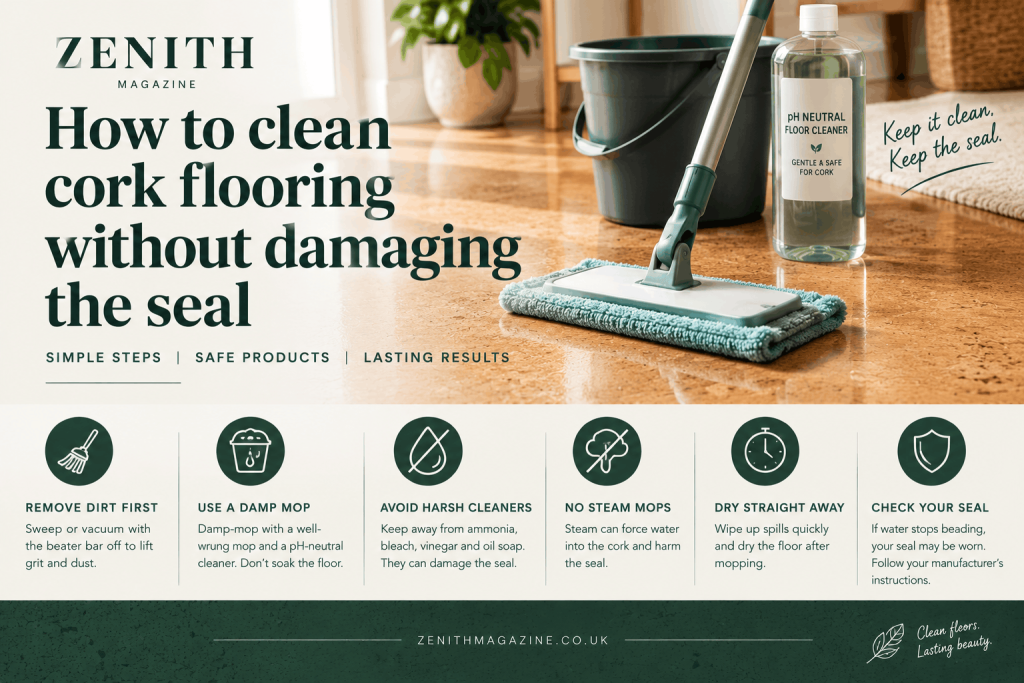
Sweep or vacuum with the beater bar off to lift grit, then damp-mop with a well-wrung mop and a pH-neutral cleaner, drying the floor straight away. Do not flood it, steam it, or use ammonia, bleach or oil soap. Check whether your cork is sealed first, because unsealed cork absorbs water far faster, and follow your manufacturer’s own instructions where they differ.
Key Takeaways
- Water and grit do most of the harm. Remove grit before any wet cleaning and keep the mop barely damp, because the sources we read all name excess water as the main risk.
- Steam mops and harsh cleaners are the products most often warned against, while advice on vinegar is split, so avoid it unless your manufacturer approves it.
- Most of the detailed guidance we found comes from US suppliers. Wicanders is the one manufacturer’s guide we could read, so your own floor’s instructions take priority.
Why a sealed cork floor is easy to damage
Cork is warm, soft and quiet underfoot, which is why people like it in kitchens and hallways. It is also porous and easy to dent, and most cork floors rely on a thin finish to keep water out.
That finish is what the article title means by the seal. This guide explains how to clean cork flooring day to day, what to use for stains and a deeper clean, and how to protect the surface. It is built from published manufacturer and supplier advice, not our own tests, and it flags where those sources disagree.
Sealed or unsealed: check before you clean
Most cork flooring sold today is finished with a sealant, usually a polyurethane or water-based acrylic, according to the Flooring Clarity guide. Unsealed cork has no such barrier and soaks up liquid.
Polyurethane sealed cork floors
On polyurethane sealed cork floors the finish does the protecting, so the aim is to clean without wearing it down. That means mild, neutral cleaners, little water and no abrasive tools. Flooring Clarity suggests watching how water behaves on the surface: if it no longer beads, the finish may be worn and need resealing. That is one site’s rule of thumb, not a test from a manufacturer, so confirm with yours.
Natural cork tile care for unsealed floors
Natural cork tile care is different. Hunker says unsealed cork should be cleared with a dry foam or rubber sponge, or vacuumed with the beater bar raised. Stains are blotted with a damp cloth and dried, and spills wiped quickly because the cork is porous and can swell or discolour. We found this in a single source, so treat it as a starting point and ask the manufacturer.
Click-lock, glue-down and engineered cork
Installation type changes where water can go, not which cleaner is safe.
- Click-lock cork plank care: planks click together over a subfloor, and Green Building Supply warns that too much water or steam can get between planks and cause mould problems on the subfloor. Wipe up spills quickly and keep the mop barely damp.
- Glue-down cork tile cleaning: none of the sources we opened gave separate instructions for glue-down tiles, so we cannot give a method that differs from the general advice below. Check the installer’s or manufacturer’s care sheet.
- Engineered cork flooring maintenance: engineered cork is made in layers, and the finish varies by product. Green Building Supply notes that a PET coating used on some waterproof, wood-look cork cannot be refinished, which is another reason to read your floor’s care sheet.
Everyday cleaning
How to clean cork floors daily
Daily cleaning is mostly dry. Hunker suggests removing dirt with a dry microfibre or push mop around three to five days a week, which is a sensible guide for a busy hallway or kitchen rather than a fixed rule.
- Remove grit with a soft broom, dry mop or suitable vacuum.
- Wipe up spills as soon as they happen.
- Once a week, or when the floor looks dull, damp-mop with a well-wrung mop.
- Dry the floor afterwards and let air circulate.
Green Building Supply recommends a vacuum or sweep followed by a weekly damp mop.
Best way to sweep cork flooring
The best way to sweep cork flooring is with a soft-bristle broom or an anti-static dry cloth mop, not a stiff brush. Wicanders suggests a vacuum or a broom handle fitted with an anti-static cloth. Ecovacs warns against abrasive tools because cork is soft and dents easily. Sweep with the planks or tiles, and clear the edges and joints, where grit collects.
Can you vacuum cork floors?
Yes, with care. Flooring Clarity and Hunker both say to use a hard-floor vacuum with the beater bar switched off, because the bar can scratch the finish. Ecovacs recommends soft-bristle tools. Wicanders names a vacuum among its approved ways to pick up dust.
Do this before every wet clean. Wicanders says to remove loose dirt first so it does not get ground into the embossing and joints.
Stains: what to try first
Act quickly. Green Building Supply says liquid left standing for around 10 hours or more can leave water marks.
| Problem | What sources suggest | Caution |
| Fresh spill | Blot with a soft cloth, then dry (Ecovacs) | Do not rub it in |
| Stuck-on dirt | Soak with neutral cleaner for a few minutes, then scrub with a soft nylon pad (Green Building Supply) | Test somewhere hidden first |
| Tougher marks | Light baking soda paste and a soft brush, then wipe and dry (Ecovacs) | Gentle pressure only |
| Ink | Isopropyl alcohol on a cotton swab, then rinse and dry (Flooring Clarity) | Test first |
| Pet accidents | Blot, then use a cork-safe enzyme cleaner (Flooring Clarity) | Do not let it soak |
| Greasy marks | Sources conflict: diluted vinegar or a drop of dish soap | See the vinegar note below |
| Deep stains | May need fine sanding and resealing (Ecovacs) | A job for the manufacturer’s method |
Light scratches can be treated with repair products, and deep gouges with wood putty, according to Green Building Supply. Do not sand cork with a heavy-duty floor sander, the same source warns.
Deeper clean without damaging the seal
Use a mild, water-based, pH-neutral cleaner. Green Building Supply gives the range as pH 7 to 9. Always test on a hidden patch first, and use a well-wrung microfibre or terry mop.
Wicanders states that its floors must only be damp-mopped and sells its own cleaners, a ready-to-use spray and a pH-neutral concentrate diluted at 50 to 100 ml per 10 litres of water. That is brand-specific, so follow the dilution on whatever product you buy.
What to avoid, and where sources disagree
| Product | What sources say |
| Steam mops | Avoid (Green Building Supply, Ecovacs, Flooring Clarity, Hunker) |
| Ammonia and bleach | Avoid (Cancork, Ecovacs, Flooring Clarity) |
| Oil soaps | Avoid (Cancork, Flooring Clarity, Hunker, which says they build up on the finish) |
| Wood floor polish | Cancork says polish leaves a residue that can stop a future coat bonding; Wicanders sells its own polish for its floors |
| Vinegar | Split: Green Building Supply lists it as something to avoid and Flooring Clarity calls it mildly acidic, while FastFloors and Hunker allow it heavily diluted |
Our reading is that vinegar is not worth the risk on a sealed floor unless the manufacturer lists it. That is a judgement, not a tested result.
How to care for cork kitchen floors
Kitchens add water, grease and sun. For how to care for cork kitchen floors, the common advice applies with extra attention:
- Wipe up spills and pet water bowl splashes straight away (Green Building Supply).
- Use breathable mats at the sink and doors. FastFloors and Parish Supply warn that rubber-backed mats can trap moisture.
- Keep indoor humidity between 30 and 60 per cent year round (Green Building Supply).
- Block strong direct sun with blinds, because FastFloors says cork is not UV-resistant and can fade.
Protecting the surface
- Felt pads under chair and table legs. Cancork also suggests coasters under heavier furniture to prevent denting.
- Lift, do not drag heavy items, and use a protective cover when moving them.
- Entrance mats to catch grit, or a shoes-off rule (FastFloors).
- Breathable chair mats under wheeled office chairs (Green Building Supply).
- Recoating: a worn finish can be renewed. Cancork suggests a refresh every 5 to 7 years depending on traffic for site-finished floors, and FastFloors says to confirm the right product with the manufacturer first. Do not apply a coat without checking, as the wrong polish can block it bonding.
Frequently Asked Questions
How should cork flooring be cleaned?
Remove grit with a soft broom or hard-floor vacuum, then damp-mop with a well-wrung mop and a pH-neutral cleaner, and dry the floor straight away. Avoid flooding, steam, ammonia, bleach and oil soaps, and check your manufacturer’s instructions for the finish.
Can you vacuum cork floors?
Yes, with the beater bar switched off, because the bar can scratch the finish. Use a hard-floor setting or soft-bristle head. Vacuum before every wet clean so grit is not dragged across the surface.
Can I use a steam mop on cork flooring?
The sources we read advise against it. Heat and moisture can get between planks and soak into the cork, which can cause swelling, staining and mould on the subfloor. Use a barely damp mop instead.
Is vinegar safe for cleaning cork floors?
Advice is split. Some guides allow heavily diluted vinegar, while others warn that it is acidic and can harm the finish. If your manufacturer does not name it, use a pH-neutral cork or hardwood cleaner instead.
How often should I clean cork flooring?
Sweep or vacuum frequently, as often as several days a week in busy areas, and damp-mop weekly or as needed. Wipe spills immediately. These frequencies come from supplier guidance, so follow your floor’s care sheet if it gives different intervals.
How do I clean a cork kitchen floor?
Treat it as any sealed cork floor, with extra care over spills. Wipe splashes at once, use breathable mats, keep the mop barely damp and dry the floor afterwards. Avoid steam and harsh cleaners near the sink and cooker.