
Quick Answer
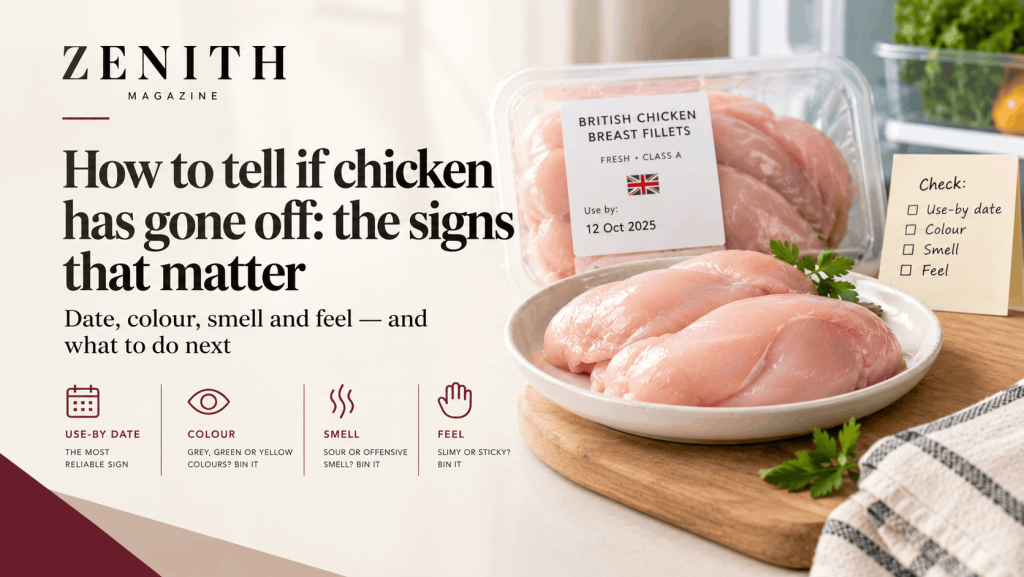
The most reliable sign is the date. The Food Standards Agency (FSA) says not to eat, cook or freeze chicken after its use-by date, and cooked leftovers should be eaten within two days. Grey or green colour, a sticky film and a sour smell mean bin it, but fresh-looking chicken can still be unsafe because food poisoning bacteria cannot be seen or smelt.
Key Takeaways
- Check the use-by date first and the storage time second. Colour, feel and smell come last, and they can only tell you chicken is bad, never that it is safe.
- The FSA says the sniff test is not suitable for food with a use-by date, yet its own survey found that most adults rely on it for raw meat.
- Do not wash chicken to “test” it or freshen it up. The FSA says splashing water can spread campylobacter around the kitchen.
Use-by dates first: how can you tell if chicken has gone bad?
How can you tell if chicken has gone bad? Start with the label, not your nose. The FSA says a use-by date is about safety: you can eat food until the end of the use-by date, but not after it, and after that date you should not eat, cook or freeze it, even if it looks and smells fine. Food Standards Scotland (FSS) says the same, and notes that raw meat is among the foods that carry use-by dates.
So how do you tell if chicken has gone bad when the date is fine? Storage matters. Chicken kept in a warm fridge, or left out of the fridge, can spoil before its date. The FSA says to keep the fridge at 5°C or below and to store raw chicken covered on the bottom shelf so juices cannot drip onto other food.
If you will not cook the chicken in time, the FSA’s advice is to freeze it before the use-by date. Which?, reporting FSA advice, says to defrost it in the fridge and cook it within 24 hours.
The FSA has found that many people do not follow this. In an FSA survey published in 2021, 76% of adults had knowingly eaten food past its use-by date, and 77% decided whether food was safe by smelling it. A quarter of men (26%) said they had sniffed cooked chicken past its use-by date and eaten it based on the smell.
How to tell when chicken has gone bad: look, feel and smell
Once the date and storage check out, your senses are a back-up. They help you spot chicken that has spoiled, but they are not proof that chicken is safe. Reliable UK agencies do not give a checklist of spoilage signs, so the signs below come from general food safety and consumer websites.
What color is bad chicken?
Raw chicken should be pale pink with white fat. Warning colours are grey, green or yellow tints, or a dull look. Healthline says to throw chicken away if it has turned yellow, green or grey, and The Kitchn recommends not using chicken that has a grey hue.
What does bad raw chicken smell like?
Fresh raw chicken has a very mild smell or none at all, according to Healthline. Bad chicken smells sour or pungent, and some people describe a sulphur-like, rotten egg smell. A noticeable sour smell means it should go in the bin.
How does bad chicken feel?
Fresh raw chicken is glossy and somewhat soft. If it is slimy, sticky or tacky, or leaves a slimy residue on your hands, that points to spoilage. Raw chicken is naturally a little moist, so what you are looking for is a thick or filmy coating, not ordinary dampness.
Quick check table
| Sign | Is it useful? | Basis |
| Past the use-by date | Yes: decisive. Do not eat, cook or freeze | FSA, FSS |
| Grey, green or yellow colour | Yes: bin it | Healthline, The Kitchn |
| Sour or sulphur-like smell | Yes: bin it | Healthline, Food Network |
| Slimy or sticky film | Yes: bin it | Healthline, The Kitchn |
| Looks and smells fine | No: does not prove it is safe | FSA |
Cooked chicken: how to tell if cooked chicken is bad
How to tell if cooked chicken is bad comes down to time again. The FSA’s advice on leftovers is to cool them quickly, cover them, get them into the fridge within one to two hours and eat them within two days. See our guide to how long cooked chicken lasts in the fridge for the full rules.
How to tell if chicken is bad after cooking
If the chicken is within its two days, signs that it has gone bad are a new sour or offensive smell, a slimy feel, a grey or green-grey colour, or mould. Cooked chicken is normally firm and drier than raw chicken, as Healthline notes, so a slimy surface is a warning. But the same rule applies as for raw chicken: smell and look cannot prove it is safe. If you cannot remember when it was cooked, throw it away.
How to tell if frozen chicken is bad
Freezing stops bacteria growing but it does not improve chicken, so the key checks are about what happened before and after freezing.
- Was it frozen in date? The FSA says to freeze food before its use-by date.
- How was it defrosted? Which?, reporting FSA advice, says to defrost in the fridge and cook within 24 hours, and never to defrost chicken at room temperature. Treat defrosted chicken as if it were fresh.
- Dry grey-brown patches are freezer burn. The US Department of Agriculture says freezer burn affects quality, not safety, as reported by US outlets such as The Kitchn. We found no UK source on this.
- A sour smell once defrosted means bin it.
If you do not know how long it has been in the freezer, label it next time. Which? advises writing the freezing date on the pack.
Myths about washing and sniffing
Myth: the sniff test works. The FSA says that for food with a use-by date it is not an appropriate method, because food can look and smell fine after that date yet contain harmful bacteria which we cannot see or smell. The FSA’s Food and You 2 survey (April to July 2024) found that 76% of respondents would rely on the sniff test to judge whether raw meat is safe to eat or cook with. A bad smell often comes from spoilage bacteria, which differ from the bacteria that cause food poisoning. That point is from a press interview with a food scientist.
Myth: washing slimy chicken makes it safe. The FSA says not to wash raw chicken, because splashing water can spread campylobacter, the most common cause of food poisoning in the UK, onto hands, worktops and utensils. The same survey found that about 38% of respondents washed raw chicken at least occasionally. Some websites suggest rinsing chicken to see if sliminess remains. We do not recommend it.
Myth: cooking it thoroughly fixes old chicken. The FSA says that after the use-by date you should not cook the food. Thorough cooking is still essential for fresh chicken, because it kills campylobacter.
How do you know if chicken has gone bad? If in doubt, bin it
How do you know if chicken has gone bad when the signs are unclear? Go back to the date and the storage. If the date has passed, or you do not know how long it has been stored, or it has been left out of the fridge, throw it away. A few pounds of chicken is cheaper than a week of illness.
Wrap it to stop juices leaking, put it in the bin, and wash your hands, the board and anything else it touched.
What happens if you eat bad chicken?
The NHS lists the symptoms of food poisoning as feeling sick, diarrhoea, being sick, stomach cramps, a temperature of 38°C or above, and feeling generally unwell. The NHS says it usually starts within a few days of eating the food, although it can start after a few hours or not for a few weeks. It is usually better within a week. The NHS names eating food after its use-by date as one way to get it.
Campylobacter symptoms usually start two to five days after eating contaminated food, according to NHS trust guidance. FSS notes that over 65s are at greater risk of serious illness. Drink plenty of fluids, and get medical advice, for example from NHS 111, if you are worried or symptoms are severe or last longer than expected.
Frequently Asked Questions
What are the real signs that raw or cooked chicken is no longer safe?
The date comes first: use-by for raw chicken, two days for cooked leftovers. Then grey or green colour, a slimy film and a sour smell mean bin it. Chicken that looks and smells fine can still be unsafe, so never rely on senses alone.
Is chicken that is slimy but smells fine safe to eat?
Not if the slime is a thick, sticky film. Healthline lists a slimy residue as a sign of spoilage, even without a bad smell. Raw chicken is naturally slightly moist, so judge the film, not the dampness. If in doubt, bin it. Do not wash it.
Chicken smells a little sour but not bad: can I still use it?
No. A sour smell is a recognised sign of spoilage, and consumer guides say to throw out chicken that smells even slightly off. Equally, no smell does not mean safe, as the FSA says bacteria that cause food poisoning cannot be smelt.
What happens if you eat bad chicken?
You may get food poisoning: sickness, diarrhoea, stomach cramps and a high temperature, usually starting within a few days, according to the NHS. Most people recover within a week. Drink plenty of fluids and seek medical advice if symptoms are severe or you are worried.
How to tell if chicken is bad after cooking?
Check the time first: the FSA advises eating cooked chicken within two days. A new sour smell, slimy surface, grey or green-grey colour or mould means throw it away. If you do not know when it was cooked, bin it.