Quick Answer
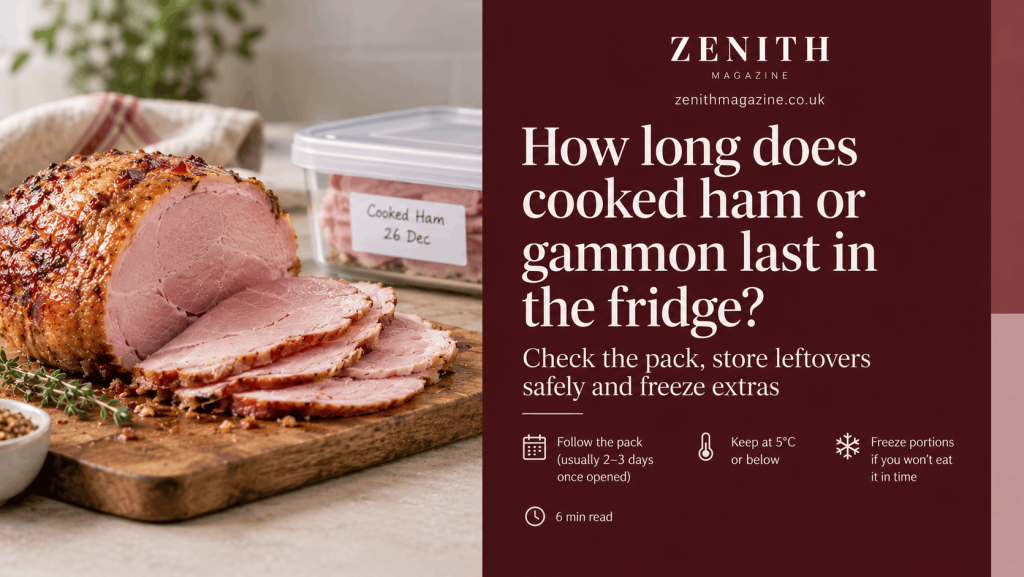
For shop-bought sliced ham, follow the pack: most say to eat it within two or three days of opening, and never after the use-by date. For home-cooked gammon, the Food Standards Agency’s (FSA) leftovers advice is two days in the fridge, although some UK food safety experts allow up to five days for a whole joint. If in doubt, freeze it.
Key Takeaways
- The label beats the general rule. Whatever a pack of ham says about use-by and “once opened” dates overrides any rule of thumb.
- Published UK advice for home-cooked ham is not uniform: two days (FSA leftovers advice) at the cautious end and up to five days (some food safety academics) at the other. We recommend the shorter limit.
- Freezing is the escape route. Portion the ham on day one or two, rather than on day four.
How long can cooked ham last in the fridge? Sliced, whole and shop-bought
How long can cooked ham last in the fridge? It depends on what kind of ham you have, because shop-bought, home-cooked, sliced and whole all carry different advice.
Shop-bought sliced ham. Check the label. The retailer labels we looked at say different things: some ready-sliced hams say to eat within two days of opening (examples include M&S, Sainsbury’s and Ocado products), while others allow three days (Houghton Hams and True Bites). All of them also say not to go past the use-by date, whichever comes first. A use-by date is a safety date, and it only applies to the pack as it was sold, stored unopened at the temperature on the label (the packs we saw said 0°C to 5°C).
Whole cooked ham joint, home-cooked. Here the published advice varies. The FSA advises eating leftovers within two days, as its guidance on cooked turkey and other roast leftovers shows. Food safety academics at Coventry University, writing in The Conversation, say a whole cooked ham can be kept in the fridge for up to five days, reducing to three days once sliced, because curing and cooking both help ham keep. That article is older than this one, and it is expert commentary rather than FSA guidance.
Home-cooked gammon. Gammon is cured pork leg, normally sold raw. Once cooked it is treated as cooked ham, so the same advice applies.
Quick-reference table
| Type of ham | Fridge life | Basis |
| Shop-bought sliced ham, opened | Follow the pack: commonly 2 days, sometimes 3, and never past the use-by date | Retailer labels |
| Shop-bought ham, unopened | Until the use-by date on the pack | Retailer labels |
| Home-cooked ham or gammon, whole joint | 2 days (FSA leftovers advice); up to 5 days according to some UK academics | FSA via press coverage; The Conversation |
| Home-cooked ham or gammon, sliced | 2 days (FSA leftovers advice); 3 days according to some UK academics | FSA via press coverage; The Conversation |
| Frozen portions, defrosted | Eat within 24 hours | FSA advice, via Company Shop |
If you are cooking for babies, older relatives or anyone with a serious illness, stay at the shorter end. The FSA has warned in the past that old leftovers carry a greater risk for the very young, the elderly and those who are seriously ill.
Gammon after Christmas: a day-by-day plan
Christmas is when most people cook a big joint and then eat from it for days, so here is a plan that follows the cautious two-day rule. Christmas Day 2026 falls on a Friday.
| Day | What to do |
| Day 0, Friday 25 December | Serve. Within one to two hours of cooking, carve the leftover meat, cover it and put it in the fridge. Label it with the date. |
| Day 1, Saturday 26 December | Eat it cold in sandwiches and salads. Freeze any portions you know you will not get through. |
| Day 2, Sunday 27 December | Last day under the FSA’s two-day advice. Finish what is left or freeze it today. |
| Day 3 onwards | Eat only frozen portions. Defrost them in the fridge and eat them within 24 hours. |
The FSA’s wider advice is to cool cooked food quickly and get it into the fridge within one to two hours, and to keep the fridge at 5°C or below. In a busy December fridge, the FSA suggests taking out anything that does not need chilling, such as unopened soft drinks or bread, so there is room for air to circulate.
If you follow the longer academic range instead, treat it as an upper limit, not a target. We have not found FSA wording that supports five days.
Wrapping and storing cooked ham in the fridge
Good storage is what makes any of these dates reliable.
- Cover it. Use a lid, foil or cling film, as NHS Forth Valley’s leftovers guidance advises, and label it with the date.
- Shelf choice. safefood, the food safety body for the island of Ireland, advises keeping cooked meats and leftovers on the middle and top shelves, with raw meat on the bottom shelf so it cannot drip onto other food.
- Keep it cold. The FSA recommends a fridge at 5°C or below, checked with a thermometer, as the dials do not always show the right temperature.
- Do not leave it out. Put it back in the fridge once you have carved what you need. safefood advises throwing away high-risk food that has been out of the fridge for more than two hours.
- Keep shop-bought ham in its pack until you open it, then follow the “once opened” instruction.
Freezing leftover ham and gammon
Freezing is the simplest way to avoid waste. The FSA advice, as relayed by Company Shop, is that if you will not eat leftovers within two days, you can freeze them, defrost them in the fridge and eat them within 24 hours.
- Check the pack. Some retailers label ready-sliced ham as not suitable for freezing, while others say it is suitable for home freezing. Follow the label.
- Freeze in portions. Cool the ham, then wrap it tightly or use an airtight container, in portions you will use in one go.
- Defrost in the fridge, not on the worktop.
- Do not leave it too long. The advice relayed by Company Shop says meat is at its best within about three months in the freezer.
For related guidance on refreezing, see our guide on whether you can refreeze chicken, and for another Boxing Day staple, how long boiled eggs keep in the fridge.
Signs that cooked ham has turned
Treat these as reasons to bin it:
- a slimy or sticky surface
- a sour or sulphurous smell
- a colour change from pink to grey or green
- any mould
These signs come from general food safety websites, not from the FSA. More importantly, they only work in one direction. Falkirk Council’s environmental health officers point out that you cannot see, taste or smell food poisoning bacteria, so ham that looks and smells fine can still be unsafe if it is past its date. If you are unsure how long it has been in the fridge, throw it away.
Frequently Asked Questions
How long can cooked ham last in the refrigerator?
For home-cooked ham, the FSA’s leftovers advice is two days, and some UK food safety experts allow up to five days for a whole joint. For shop-bought ham, follow the pack: it usually says two or three days once opened. We recommend the shorter limit.
How long does shop-bought sliced ham last once opened?
The label decides. Several ready-sliced hams we checked say to eat within two days of opening, and others say three days. Either way, do not go past the use-by date, and keep it in the fridge at 5°C or below.
How long can cooked gammon last in the fridge?
Cooked gammon is treated as cooked ham, so the same advice applies: two days under the FSA’s leftovers advice, with some experts allowing up to five days for a whole joint. After a big Christmas joint, freezing portions by Boxing Day is the safest plan.
Can you freeze cooked ham?
Yes, in most cases. Freeze it in portions, defrost it in the fridge and eat it within 24 hours. Check the pack first, as some shop-bought sliced hams are labelled as not suitable for home freezing.
Can you eat ham after the use-by date?
No. A use-by date is about safety, not quality. The FSA’s advice is to freeze food before its use-by date if you will not eat it in time, and packs say not to exceed the date shown.
Can you eat cooked ham cold?
Yes. Shop-bought ham is sold ready to eat. Home-cooked ham can also be eaten cold if it was cooked thoroughly, cooled and put in the fridge within one to two hours, and eaten within the date limits above.